Dr Jesvir Kaur Mahil · September 2026
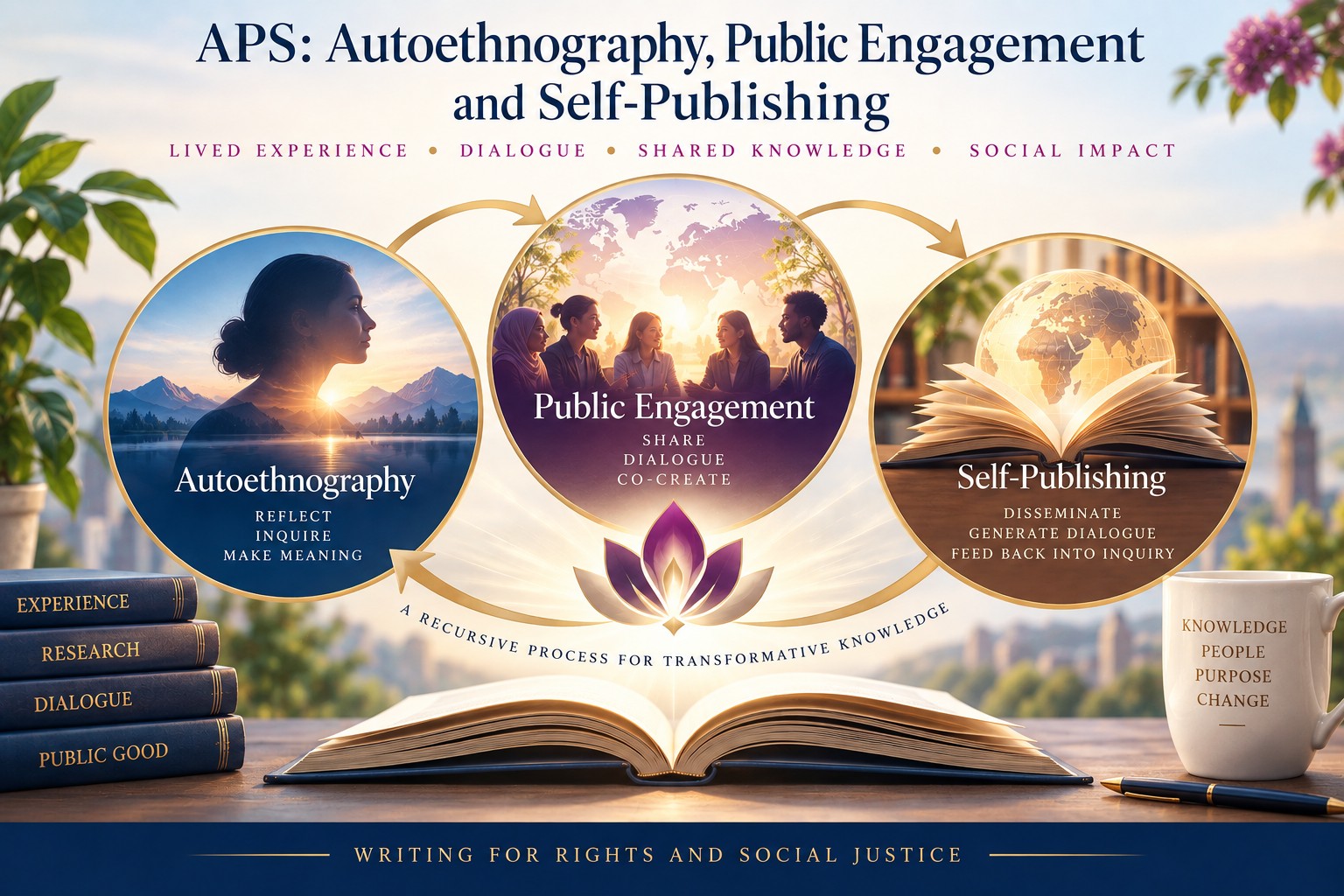
This article introduces APS—Autoethnography, Public Engagement and Self-Publishing—as an integrated and recursive methodological approach to knowledge creation. APS begins with lived experience and reflective inquiry, moves knowledge into dialogue with wider publics, and uses self-publishing not simply as a final act of dissemination but as a methodological process through which public response can feed back into reflection, interpretation and further inquiry.
Knowledge is never produced in a vacuum. It emerges through lived experience, interpretation, relationships, dialogue and the social contexts within which people seek to understand themselves and the world around them. Yet conventional academic models can separate the production of knowledge from the people and communities whose lives, experiences and concerns give that knowledge meaning.
APS—Autoethnography, Public Engagement and Self-Publishing—offers an alternative, recursive approach. It brings together three practices that are often treated separately: autoethnography as a means of critically examining lived experience; public engagement as a space for dialogue, co-creation and collective meaning-making; and self-publishing as a means not only of disseminating knowledge but of returning emerging ideas to wider publics.
The distinctive proposition of APS is therefore that publication need not mark the end of inquiry. Knowledge can be shared while it is developing; public response can generate new questions, perspectives and interpretations; and these can feed back into further reflection and inquiry. APS can consequently be understood as a recursive process through which experience, reflection, dialogue, publication and renewed inquiry continually inform one another.
Autoethnography provides the first element of APS because it recognises lived experience as a legitimate source of knowledge and critical inquiry. Rather than treating the researcher as detached from the phenomenon being studied, autoethnography makes the relationship between personal experience, social context and knowledge production explicit. Ellis, Adams and Bochner (2011) describe autoethnography as an approach that uses personal experience to describe and critically examine wider cultural beliefs, practices and experiences.
Within APS, however, lived experience is not treated simply as personal testimony. The purpose is to move reflexively between the personal and the social: asking how an individual experience may illuminate wider institutional, cultural or systemic processes. This requires attention to positionality and reflexivity—how the researcher’s identities, relationships, assumptions, values and location within a particular context shape what can be seen, interpreted and communicated.
Autoethnography can therefore make visible forms of knowledge that may be difficult to capture through more detached research approaches. Experience becomes material for critical inquiry: it can be documented, revisited, interpreted and placed in conversation with theory, documentary evidence and the experiences of others. The personal becomes analytically significant not because one individual experience can automatically be generalised, but because close examination of lived experience can expose tensions, structures and meanings that invite wider investigation.
This also creates ethical responsibilities. Autoethnographic accounts inevitably involve relationships with other people and may concern experiences of vulnerability, conflict, inequality or harm. Reflexivity must therefore extend beyond the researcher’s own interpretation to questions of representation, relational ethics, power and consequence. What is written, what is withheld, whose voices become visible, and how other people are represented are methodological as well as ethical decisions.
In APS, this reflective process provides a starting point rather than an endpoint. Insights generated through autoethnographic inquiry are subsequently brought into dialogue with wider publics. This movement from lived experience → critical reflection → public dialogue creates the bridge to the second component of APS: Public Engagement.
Public engagement forms the second component of APS. If autoethnography begins by examining lived experience, public engagement deliberately moves emerging knowledge beyond the private sphere and into dialogue with others. The researcher is no longer simply interpreting experience and subsequently presenting conclusions to an audience; engagement itself becomes part of the process through which meaning is developed, questioned and refined.
This conception goes beyond public engagement understood primarily as communicating completed research. Within APS, engagement can involve conversations, workshops, conferences, presentations, community encounters, online dialogue and other spaces in which emerging ideas are exposed to different perspectives. Participants are therefore not merely recipients of knowledge. Their questions, interpretations, challenges and experiences can contribute to its continuing development.
This orientation has affinities with participatory and co-produced approaches to research, which seek to challenge rigid distinctions between those who produce knowledge and those who are positioned as its subjects or audiences. It also resonates with Habermas’s theory of communicative action, particularly the possibility of developing understanding through dialogue in which claims can be questioned, contested and reconsidered. APS does not assume that public dialogue is automatically equal or free from power; rather, it treats the conditions under which dialogue occurs as themselves worthy of critical attention.
Public engagement therefore introduces plurality into the inquiry. An interpretation that appears convincing within an individual’s reflective account may look different when encountered by people with different experiences, cultural locations or forms of expertise. Dialogue can affirm an interpretation, complicate it, reveal what has been overlooked, expose disagreement or generate entirely new questions.
This has particular significance for epistemic justice. Whose knowledge is recognised, whose testimony is believed, who has access to established platforms of knowledge production, and whose interpretations are marginalised are questions of power. By deliberately creating spaces in which lived, professional, community and academic forms of knowledge can encounter one another, APS seeks to broaden participation in knowledge-making without pretending that inequalities of voice and authority simply disappear.
Within the recursive APS process, public engagement consequently performs two functions: it shares emerging knowledge and simultaneously generates new knowledge. Dialogue becomes methodological data—not in the sense that every public response must be formally collected and analysed, but because engagement can reshape the researcher’s questions, interpretations and subsequent inquiry.
The process therefore moves from:
Autoethnography → Public Engagement
but it does not stop there. The next methodological question is how emerging knowledge can be placed into wider circulation in ways that remain accessible, responsive and capable of generating further dialogue. This leads to the third component of APS: Self-Publishing.
Self-publishing forms the third component of APS, but its role requires careful distinction. In conventional accounts of research, publication is commonly positioned at the end of a largely linear process: research is undertaken, findings are established, and the completed knowledge is subsequently disseminated. Self-publishing could easily reproduce this model, differing only in who controls the means of publication.
APS proposes something more methodologically significant. Self-publishing can create opportunities to place emerging knowledge into public circulation without waiting for conventional academic publication cycles or relying exclusively upon institutional gatekeepers. Websites, independently published books and papers, digital platforms, newsletters, recordings and other forms of public scholarship can enable researchers to communicate directly with wider audiences.
The significance of this autonomy is not simply speed or accessibility. Control over publication can affect what knowledge becomes visible, whose knowledge is authorised, when it can enter public discussion, and which audiences are able to encounter it. This becomes especially important where research addresses marginalised experience, contested knowledge, social injustice or issues that may not fit comfortably within established institutional or disciplinary boundaries.
Yet APS does not treat the absence of conventional gatekeeping as an absence of scholarly responsibility. Self-publishing increases the importance of transparency about evidence, methodology, positionality, ethical decision-making and the status of claims. Independence from formal publication structures should not mean independence from intellectual rigour.
Most importantly, APS distinguishes self-publishing as dissemination from self-publishing as a methodological act. If publication merely makes completed findings available, it remains the final stage of a linear research process. If, however, published work generates questions, dialogue, critique, testimony, new relationships or alternative interpretations that subsequently influence reflection and further inquiry, publication becomes part of the research process itself.
The methodological sequence therefore changes from:
Research → Publication
to a recursive movement:
Reflection → Engagement → Publication → Public Response → Renewed Reflection → Further Inquiry
In this formulation, publication does not close the inquiry. It creates another point of encounter. Knowledge enters the public realm, generates response and can return to the researcher in altered form. The boundary between knowledge production and knowledge dissemination consequently becomes more permeable.
This recursive function is central to APS. Self-publishing is not simply where the research ends; it can become one of the means through which the research continues.
APS is best understood not as three separate research activities but as a recursive methodological system. Autoethnography, public engagement and self-publishing each perform a distinctive function, yet their methodological value is strengthened through their interaction.
Autoethnography creates a space for examining lived experience reflexively and connecting the personal with wider social, cultural and institutional contexts. Public engagement moves emerging interpretations into dialogue with others, allowing them to be questioned, enriched, challenged or reframed. Self-publishing places developing knowledge into wider circulation, creating further opportunities for encounter and response.
The process can therefore be represented as:
Autoethnography → Public Engagement → Self-Publishing → Public Response → Further Reflection and Inquiry
However, even this representation should not be understood as a fixed sequence. Researchers may move backwards and forwards between these activities. A public conversation may trigger renewed autoethnographic reflection before anything is published. A published account may lead to an unexpected relationship or testimony. New documentary evidence may require earlier interpretations to be reconsidered. Further reflection may generate another public intervention, which in turn produces new dialogue.
APS is consequently better represented as a cycle than a pipeline. Knowledge remains capable of revision as it moves between experience, reflection, dialogue and public expression. This does not mean that all interpretations remain permanently provisional or that evidence has no stability. Rather, it recognises that knowledge-making is relational and that new encounters can change what becomes visible or meaningful.
The recursive character of APS also changes the relationship between researcher and audience. An audience need not exist only at the end of the research process as the recipient of findings. Publics can become participants in the intellectual environment through which inquiry develops. Their responses may expose assumptions, introduce alternative perspectives, identify connections or raise questions that the researcher could not have generated alone.
This is particularly important where inquiry concerns complex social phenomena and questions of injustice. Such issues rarely yield to a single perspective or moment of analysis. Recursive inquiry enables the researcher to revisit experience and interpretation as additional voices, evidence and contexts emerge.
APS therefore treats knowledge creation as an evolving relationship between self, others and the public realm. Its central methodological proposition is not simply that researchers should reflect, engage and publish, but that these activities can be deliberately connected so that each iteration creates the possibility of further learning and inquiry.
The recursive and public character of APS creates significant ethical responsibilities. Moving lived experience into public dialogue and publication involves not only questions of what can be known, but also who is represented, who is heard, who may be affected and who has the power to shape the resulting account.
Relational ethics is particularly important within autoethnographic inquiry because an account of one’s own experience frequently involves the lives and actions of other people. The researcher therefore has responsibilities that cannot always be satisfied through procedural ethics alone. Decisions about naming, anonymity, disclosure, context and representation require continuing judgement about potential consequences for individuals and communities, as well as consideration of the public interest in making particular experiences visible.
These responsibilities become more complex as inquiry moves into public engagement. Dialogue does not occur on a level playing field. Differences in institutional authority, professional status, cultural and social capital, access to platforms, confidence, language and established credibility can shape whose contributions are heard and whose interpretations acquire legitimacy. Public engagement should therefore not be romanticised as inherently democratic or inclusive.
APS requires attention to the conditions of participation as well as participation itself. Who has been invited into the conversation? Who is absent? Who feels able to challenge an interpretation? Which forms of expression are recognised as legitimate knowledge? Who controls the platform through which dialogue takes place? Such questions make power part of the methodological analysis rather than treating it as external to the research process.
This connects APS directly with the concept of epistemic justice. Fricker’s (2007) account of epistemic injustice draws attention to ways in which people can be wronged specifically in their capacity as knowers. Testimonial injustice can occur when prejudice leads a person’s account to receive less credibility than it warrants, while hermeneutical injustice concerns unequal access to the interpretive resources through which experiences can be understood and communicated.
Public scholarship and self-publishing can potentially create alternative spaces in which marginalised or insufficiently recognised knowledge becomes visible. They can enable people to develop language for experiences that established institutions or knowledge systems have failed adequately to recognise. But creating an alternative platform does not itself guarantee epistemic justice. Researchers must remain attentive to whose voices they amplify, how they interpret responses, which contributions they select and the authority they themselves exercise as authors and publishers.
APS therefore combines methodological openness with ethical accountability. Its aim is not simply to increase the volume of public participation, but to create more reflective relationships between experience, voice, power, dialogue and knowledge. The recursive cycle provides repeated opportunities to question not only what do I now know? but also how has this knowledge been produced, whose perspectives have shaped it, whose may still be missing, and what responsibilities arise from making it public?
Public scholarship provides an important context for understanding the wider purpose of APS. Academic knowledge has traditionally circulated through journals, books, conferences and institutions whose conventions can limit who is able to produce, access and participate in scholarly conversations. Paywalls, specialist language, lengthy publication processes and institutional gatekeeping can create considerable distance between research and the publics whose lives may be directly connected with it.
APS seeks to reduce that distance. Through public engagement and self-publishing, researchers can create more direct routes between inquiry and wider communities. Websites, open-access papers, public presentations, independently published books, videos, podcasts and other accessible formats can enable knowledge to travel beyond conventional academic boundaries and encounter people with different forms of expertise and lived experience.
The democratisation of knowledge, however, involves more than making academic outputs freely available. Access is not the same as participation. A research paper may be publicly accessible while the underlying processes through which its questions, interpretations and conclusions were constructed remain largely closed to public influence.
APS makes a stronger proposition. Publics can potentially participate not only in receiving knowledge but also in its continuing formation. Questions, responses, disagreement, testimony and dialogue generated through engagement with published work can become resources for further reflection and inquiry. Public scholarship thereby becomes connected to methodology rather than functioning solely as outreach.
This approach also invites reconsideration of what counts as scholarly contribution. Knowledge may be communicated through forms that are more immediate, creative, narrative or accessible than conventional academic writing while still being grounded in evidence, critical reflection, theoretical engagement and ethical responsibility. Scholarly rigour need not depend upon restricting knowledge to scholarly audiences.
At the same time, democratisation should not be confused with the idea that every claim has equal evidential standing. APS does not reject expertise, peer review or established scholarship. Rather, it challenges the assumption that these constitute the only legitimate routes through which valuable knowledge can emerge or acquire public significance. Academic literature, documentary evidence, professional expertise, lived experience and public dialogue can be brought into critical relationship with one another.
APS therefore positions public scholarship as part of a broader commitment to knowledge that is rigorous but accessible, reflective but dialogic, independently voiced but accountable, and capable of contributing to social understanding and change.
APS brings together autoethnography, public engagement and self-publishing as an integrated approach to knowledge creation. Its contribution lies not simply in combining three established practices, but in connecting them recursively so that lived experience can generate inquiry, inquiry can enter public dialogue, publication can generate response, and that response can return to reflection and further research.
This challenges the conventional distinction between knowledge production and knowledge dissemination. Within APS, communication with wider publics need not wait until research has been completed. Engagement and publication can themselves become sites of learning, questioning and knowledge development.
Such openness also brings responsibilities. Public and independently published scholarship requires careful attention to evidence, reflexivity, relational ethics, representation and power. The capacity to publish without conventional institutional gatekeepers increases rather than diminishes the researcher’s responsibility to distinguish evidence from interpretation, acknowledge uncertainty, engage seriously with alternative perspectives and remain accountable for what is placed into the public realm.
APS is particularly relevant to inquiry concerned with rights and social justice because experiences of inequality, exclusion and harm are not always adequately represented within established knowledge structures. Autoethnography can make lived experience visible; public engagement can bring different forms of knowledge into dialogue; and self-publishing can create routes through which emerging understanding enters public discourse without being wholly dependent upon institutional permission.
The phrase Writing for Rights and Social Justice therefore expresses more than a publishing objective. It describes an orientation towards knowledge-making in which writing becomes a means of reflection, dialogue, visibility and public participation. The purpose is not simply to speak about people or social problems, but to contribute to processes through which experience can be examined, knowledge contested and alternative understandings created.
APS remains an evolving methodological proposition rather than a closed formula. Its recursive character means that the framework itself can develop through practice, critique and public engagement. In that sense, APS applies its own methodological principle to itself: reflection generates dialogue; dialogue generates knowledge; knowledge is made public; and what returns from the public realm creates the possibility of beginning again.
Abbott, S. W., & Tiffen, B. (2019). Democratising the knowledge commons: The shared goals of open and community-engaged scholarship. Gateways: International Journal of Community Research and Engagement, 12(2).
Baum, F., MacDougall, C., & Smith, D. (2006). Participatory action research. Journal of Epidemiology and Community Health, 60(10), 854–857.
Bourdieu, P. (1986). The forms of capital. In J. G. Richardson (Ed.), Handbook of Theory and Research for the Sociology of Education. Greenwood. See also subsequent reproduced editions.
Boyer, E. L. (1996). The scholarship of engagement. Journal of Public Service & Outreach, 1(1), 11–20.
Ellis, C. (2007). Telling secrets, revealing lives: Relational ethics in research with intimate others. Qualitative Inquiry, 13(1), 3–29.
Ellis, C., Adams, T. E., & Bochner, A. P. (2011). Autoethnography: An overview. Forum Qualitative Sozialforschung / Forum: Qualitative Social Research, 12(1).
Fricker, M. (2007). Epistemic Injustice: Power and the Ethics of Knowing. Oxford University Press.
Habermas, J. (1984). The Theory of Communicative Action, Volume 1: Reason and the Rationalization of Society. Beacon Press. [Originally published in German, 1981.]
Habermas, J. (1987). The Theory of Communicative Action, Volume 2: Lifeworld and System: A Critique of Functionalist Reason. Beacon Press.
Heron, J., & Reason, P. (2001). The practice of co-operative inquiry: Research with rather than on people. In P. Reason & H. Bradbury (Eds.), Handbook of Action Research: Participative Inquiry and Practice. Sage.
Lenette, C. (2022). Participatory Action Research: Ethics and Decolonization. Oxford University Press.
Reason, P., & Bradbury, H. (Eds.). (2008). The SAGE Handbook of Action Research: Participative Inquiry and Practice (2nd ed.). Sage.
UK Research and Innovation. (2026). Co-production in research.
UK Research and Innovation. (2026). Guidance on engaging the public with your research.
This article develops an ongoing methodological approach created by Dr Jesvir Kaur Mahil through the integration of Autoethnography, Public Engagement and Self-Publishing (APS). The framework has emerged through reflective practice, public scholarship and ongoing autoethnographic research, including the Phoenix Rising in Gaza project.
APS is presented here as an evolving methodological proposition rather than a fixed model. Its distinctive contribution is the treatment of self-publishing not simply as the dissemination of completed research, but as a methodological act through which emerging knowledge can enter the public realm, generate dialogue and response, and feed back into further reflection and inquiry.
This article forms part of an ongoing programme of writing and research concerned with knowledge creation, epistemic justice, rights and social justice.
© 2026 Dr Jesvir Kaur Mahil. All rights reserved.
This article may be shared by linking to this webpage. Please do not reproduce or republish the text without permission.