Dr Jesvir Kaur Mahil · September 2026
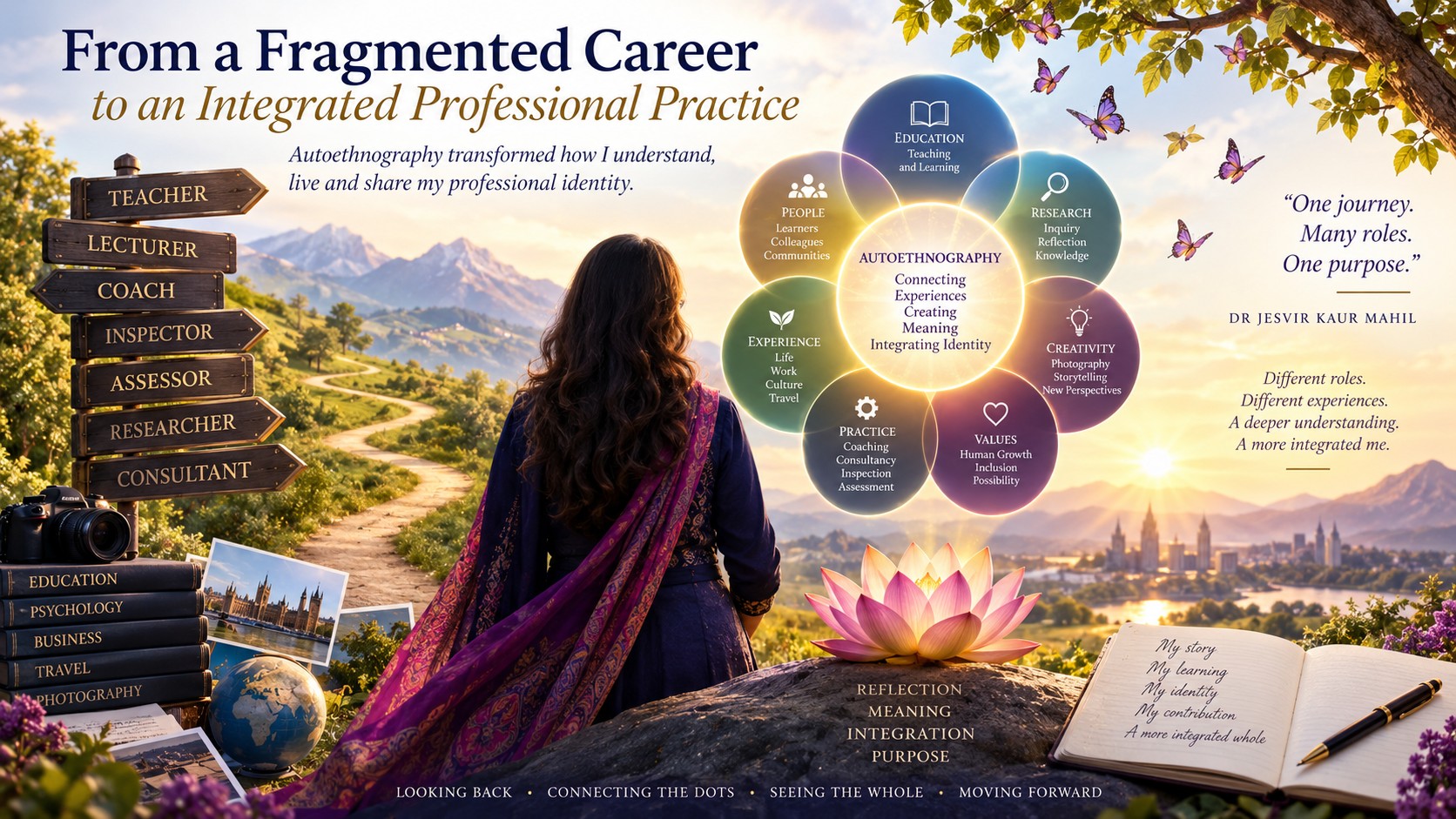
For much of my career, I understood myself through a succession of professional roles: teacher, lecturer, coach, inspector, assessor, researcher and consultant. Autoethnography transformed that understanding. By looking backwards across more than four decades in education, I began to see not a fragmented career but an interconnected professional journey — one in which apparently separate experiences, identities and ways of knowing could become part of a more integrated whole.
For much of my career, I described myself through a succession of professional roles: teacher, lecturer, coach, inspector, assessor, researcher and consultant. Each role represented a substantial body of knowledge and experience, yet for many years I tended to regard them as separate parts of my professional life.
Autoethnography changed that.
It provided me with a way of looking backwards across more than four decades in education, not simply to document what had happened, but to ask what those experiences meant, how they had shaped me and how seemingly disconnected parts of my career might form a coherent whole.
When I undertook autoethnographic research for my M.Ed., my central question was:
“How can I synthesise fragmented aspects of my career in education (teacher, lecturer, coach, researcher, assessor, inspector) using an auto-ethnographic approach to create a cohesive story of myself as an educator?”
That question has become increasingly important to me.
Several years later, I no longer see autoethnography simply as a research methodology I have learned to use. It has become an important part of how I understand my professional identity and how I generate knowledge from experience.
My educational journey began long before I became a professional educator.
I first learned to read and write Panjabi as a young child in the village of Mahil Gaila in Panjab. I was regarded as a fast learner and began school early. When my family migrated to England, however, I entered a completely different educational world. Unable to speak English, I moved from being highly successful in my Panjabi school to being placed in a remedial class in England.
That experience subsequently influenced how I taught English to refugees, immigrants and international learners. It taught me something I have carried throughout my career:
never confuse unfamiliarity with lack of intelligence.
A learner may know very little of the particular language, curriculum or cultural code valued by an institution while possessing considerable knowledge, intelligence and wisdom that the institution has failed to recognise.
This is one reason my starting question when designing learning has increasingly been:
WHO am I teaching?
rather than simply:
WHAT am I teaching?
My M.Ed. reflection connected this orientation with the humanistic psychology that influenced me during my Psychology degree, particularly the work of Carl Rogers and Abraham Maslow. I came to understand education as something fundamentally concerned with human growth, agency and potential, rather than merely the transmission of curriculum content.
Autoethnography enabled me to recognise these connections retrospectively.
One of the most powerful exercises in my M.Ed. autoethnography was examining “The Paths That I Did Not Follow.”
I had wanted to undertake doctoral research after graduating in Psychology in 1982. Instead, my subsequent journey included teacher training, teaching abroad, documentary photography, teaching English to refugees and immigrants, completing an MBA, becoming a coach, establishing a consultancy, working as an inspector and eventually undertaking doctoral research in Education.
My PhD was completed more than three decades after I had first contemplated undertaking one.
Viewed through a conventional academic lens, this could be interpreted as a delayed or disrupted academic trajectory.
Autoethnography helped me see something different.
The apparent detours had given me experiences that a more linear academic career might never have provided. My M.Ed. reflection therefore reached an important conclusion:
“Autoethnography is a researcher identity that fits perfectly with who I am and who I aspire to become.”
The teacher, traveller, photographer, business graduate, coach, consultant, inspector and researcher were not competing identities.
They were different ways of learning to see.
That recognition fundamentally altered how I understood myself professionally.
As an educator, autoethnography has strengthened my conviction that learners arrive with histories.
No learner enters a classroom as an empty vessel.
People bring languages, cultures, memories, professional expertise, informal learning, family experiences, aspirations, fears, values and ways of making meaning. Some of these are visible to an educator; much remains beneath the surface.
This aligns strongly with my interest in Systems Thinking. The iceberg metaphor that I have frequently used in my educational work reminds us that visible behaviour may be generated by much deeper and less visible forces.
My M.Ed. research reinforced the importance of learner choice, prior knowledge, storytelling, multiple perspectives, collaboration and co-creation. It also challenged the assumption that the impact of teaching can necessarily be measured immediately.
One participant in my Leadership, Learning and Coaching research described actions undertaken after the workshop that an observer evaluating the session itself could never have predicted.
This strengthened a principle that continues to influence my educational philosophy:
some of our deepest learning becomes visible long after the teaching intervention has ended.
Education therefore requires humility. We cannot always know what another person has learned simply because we have assessed what they can demonstrate at a particular moment.
Autoethnography has also changed my understanding of what it means to be a researcher.
Traditional conceptions of research can encourage researchers to distance themselves from the phenomenon being studied. Autoethnography begins somewhere different: it acknowledges that the researcher has a history, perspective, position and relationship to the knowledge being produced.
In my M.Ed. I explicitly recognised that my interpretations were shaped by my “personal history, previous experiences, values, beliefs, assumptions” and unconscious dynamics.
Rather than pretending these influences do not exist, autoethnography requires me to interrogate them.
That does not mean that personal experience automatically constitutes evidence of everything I might believe about the wider world. Quite the opposite. Rigorous autoethnography requires movement between experience, reflexivity, evidence, theory, context and alternative interpretations.
My Systems Thinking background is particularly useful here.
An individual experience can be examined at a micro level while simultaneously asking what organisational, cultural, historical and structural forces might be operating at the macro level.
The task is not simply to tell what happened to me. It is to ask:
What might this experience reveal that is difficult to see when we look only at systems, policies, statistics or institutional narratives?
This approach has become increasingly important in my recent research into educational inequality, cumulative disadvantage, epistemic injustice and institutional regimes of knowledge.
There is another important continuity in this story.
When I graduated in Psychology at the age of 21, I wanted to become a writer.
For many years that aspiration sat alongside my professional career rather than at its centre. Autoethnography has helped reconnect the two.
Writing is no longer something separate from my research. Writing can itself become a method of inquiry.
A remembered incident changes when I write about it. Questions emerge. Contradictions become visible. Events that seemed unrelated begin to form patterns. I notice what I previously ignored. I ask what is missing. I reconsider my own interpretation.
This is why storytelling has become so important to my scholarship.
In my M.Ed. research I argued that stories can synthesise complex, interconnected information while providing enough contextual richness for multiple interpretations. Stories can communicate not only through what is explicitly stated but through “absence, undertones and exclusion.”
For me, therefore, writing is not merely the final stage through which completed research is communicated.
Writing is part of thinking.
And increasingly, writing publicly is part of my scholarship.
My coaching practice has also shaped the kind of autoethnographer I have become.
Good coaching depends less upon providing answers than upon asking questions capable of generating insight.
My M.Ed. research crystallised this distinction through a simple change of question. I moved from asking:
“How can I overcome the obstacles preventing me from fulfilling my potential?”
towards asking:
“How can I use my knowledge, skills and experiences most creatively to advance in my journey to become a professor?”
The circumstances had not magically changed.
The question had.
And the new question created different possibilities for action.
This remains one of autoethnography’s most important contributions to my professional identity. Reflexivity is not merely looking backwards. At its best, it changes the questions through which we construct the future.
My identity as a coach therefore complements my identity as an autoethnographic researcher. Both require curiosity, listening, reflexivity, tolerance of uncertainty and willingness to enter spaces in which the answer is not already known.
Consultancy could appear to sit at the opposite end of the spectrum from autoethnography. Consultants are often expected to arrive with expertise and solutions.
My experience has taught me to be wary of that model.
Complex organisational problems rarely exist independently of their histories, relationships, cultures, power structures and competing interpretations. A solution that works in one part of a system can generate an unforeseen problem elsewhere.
The consultant therefore needs to be a learner as well as an expert.
This is closely connected to the Leadership, Learning and Coaching (LLC) framework I explored through my M.Ed. research. Rather than treating leader, learner and coach as separate identities, I examined what becomes possible when they operate together.
My research led me to argue that fragmentation can create tension whereas synthesis can create something generative: the whole can become greater than the sum of its parts.
I now apply that principle much more broadly.
My consultancy practice does not sit outside my teaching, research, coaching and writing.
It draws upon all of them.
Perhaps the most important impact of autoethnography on my professional identity concerns belonging.
My M.Ed. research distinguished between fitting in and belonging. I reflected on the tension created when people have to fragment themselves in order to fit within spaces too narrowly defined to accommodate their whole identities.
That insight has acquired much greater significance for me since writing the M.Ed. artefact in 2022.
My subsequent professional experiences have forced me to think more deeply about who has the authority to produce knowledge, whose interpretations acquire institutional credibility and what happens when lived experience challenges an established organisational account.
Autoethnography gives me a means of refusing a false choice between being the person who experienced something and the researcher who analyses it.
I can be both.
But that dual position carries responsibility. I must remain reflexive about my interpretations, distinguish observation from inference, consider alternative explanations and place individual experience within wider evidence and scholarship.
That is particularly important when writing about contested experiences.
My understanding of autoethnography is now developing beyond the approach I articulated in my M.Ed.
In 2022, I wrote that my professional influence was expanding through articles, videos and social media, and I intended to build upon my autoethnographic work by publishing accounts of my journey from which others might learn.
I can now see a further possibility.
Rather than regarding publication merely as the final stage of research —
research → write → publish
—I am increasingly interested in a recursive relationship:
experience → reflection → inquiry → writing → publication → public engagement → further reflection → new inquiry
This is an important development in my methodological thinking.
Self-publishing, public engagement and my websites can therefore do more than disseminate research that has already been completed. They can create spaces in which ideas encounter other experiences, interpretations, questions and challenges. Those responses can subsequently become catalysts for deeper inquiry.
In this sense, scholarship becomes less like a finished product and more like an evolving conversation.
The diagram I created for my M.Ed. showed my professional identities moving from fragmentation towards synthesis. Teacher, coach, assessor and researcher were represented as increasingly encompassing dimensions of an emerging professional identity.
I would draw that diagram differently today.
I no longer think that one professional title needs to sit above all the others.
I see something closer to an interconnected system:
Educator ↔ Researcher ↔ Writer ↔ Coach ↔ Consultant
Each changes the others.
The educator keeps my research connected with learning.
The researcher requires me to question what I think I know.
The writer turns experience and inquiry into communicable knowledge.
The coach reminds me that powerful questions can matter more than predetermined answers.
The consultant tests whether ideas remain useful when they encounter the complexity of real organisations and human lives.
And autoethnography provides a connective thread between them all.
This represents a significant change from the aspiration expressed in my M.Ed. research. At that time, becoming a Professor in Education represented the synthesis towards which my fragmented career appeared to be moving.
Today, the deeper goal is not simply acquiring a particular institutional title.
It is becoming whole as a scholar and practitioner.
Autoethnography has helped me recognise that a career need not be linear to possess coherence. The paths I followed — and those I did not follow — have produced the educator, researcher, writer, coach and consultant I have become.
The question I therefore ask myself today is subtly different from the question with which I began my M.Ed. inquiry.
It is no longer:
How do I make these fragmented professional identities fit together?
It is:
What becomes possible when I recognise that they were never truly separate in the first place?
This article draws upon and extends reflections first developed as part of my Master of Education (M.Ed.) research, in which I used autoethnography to explore the development of my professional identity across a career spanning multiple roles in education. In that earlier work, I reflected on my experiences as a teacher, lecturer, coach, assessor, inspector and researcher, asking how these apparently fragmented identities might be synthesised into a more coherent understanding of myself as an educator.
Written several years later, this article revisits those reflections from a different point in my professional and scholarly journey. It therefore represents both continuity and development in my autoethnographic inquiry. Rather than treating my M.Ed. reflections as a finished account of who I was, I return to them as evidence of an evolving professional identity. My subsequent experiences of research, writing, coaching, consultancy and public scholarship have enabled me to reinterpret the significance of that earlier work.
In this sense, the article also demonstrates something fundamental about autoethnography itself: our understanding of lived experience is not fixed. We can return to earlier experiences, writings and interpretations from a different position in time and discover relationships, patterns and meanings that were not previously visible.
My journey from understanding my professional roles as separate or nested identities towards seeing myself more holistically as an educator, researcher, writer, coach and consultant is itself part of that continuing autoethnographic process.
Dr Jesvir Kaur Mahil (September 2026)
© 2026 Dr Jesvir Kaur Mahil. All rights reserved.
This article may be shared by linking to this webpage. Please do not reproduce or republish the text without permission.