Dr Jesvir Kaur Mahil · September 2026
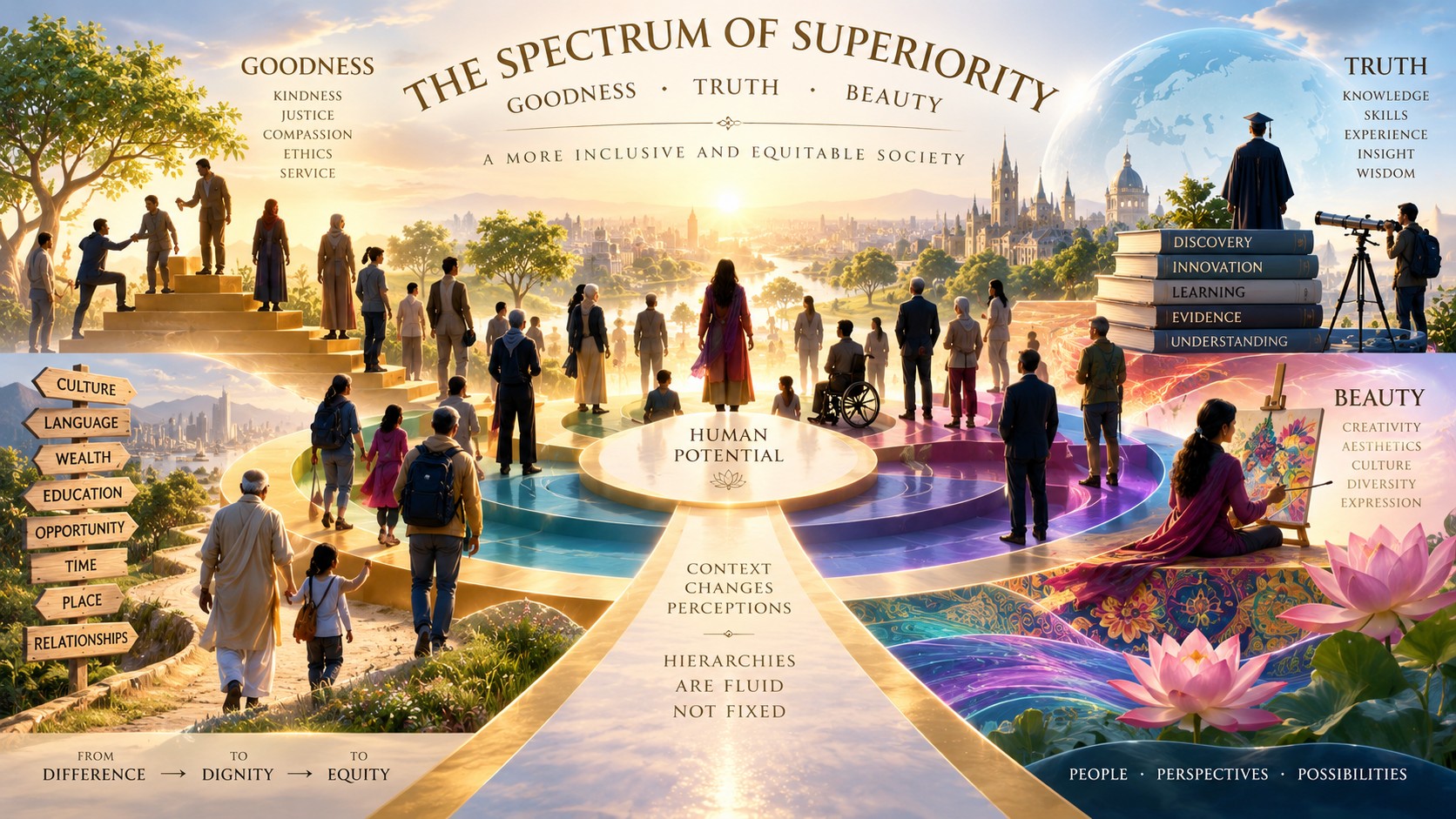
Human beings continually make comparisons—about knowledge, wealth, appearance, morality, status, belonging and countless other characteristics. From these comparisons we construct visible and invisible hierarchies of superiority. Yet these hierarchies are neither simple nor fixed. Drawing on personal reflection, migration experience and ideas of goodness, truth and beauty, this article explores superiority as a dynamic and multidimensional spectrum, shaped by culture, context, time, relationships and changing social values. It asks us to look beyond simplistic rankings of human worth and towards a more important question: what becomes possible when we stop trying to establish who is superior and begin recognising the different forms of value that human beings contribute?
From the moment we enter the world, we begin to encounter differences in power, capability and dependence.
As children, we literally look upwards towards people who are taller, stronger and more capable of feeding us, protecting us and helping us grow. Strength and capability can become associated with safety, provision and authority.
As we grow, comparison becomes more complex.
We encounter differences in wealth, education, knowledge, appearance, morality, social status, cultural belonging, influence and opportunity.
From these differences, consciously and unconsciously, human beings construct hierarchies.
We look upwards towards some people and downwards towards others.
Repeated across families, institutions, communities and societies, these comparisons can become deeply embedded heuristics about who possesses value, who deserves respect, who belongs and who is considered superior.
But superiority is rarely determined by one characteristic.
It is better understood as a dynamic spectrum in which multiple variables intersect and change over time.
My own family history provides an example.
When my family and I arrived in England from Panjab during the 1960s, we entered a society in which we could readily be viewed through a downward gaze.
By dominant social standards, migrant families like ours could appear poor, relatively uneducated, linguistically unfamiliar and culturally out of step with the society into which we had arrived.
These characteristics affected how others perceived us and where we were positioned within existing social hierarchies.
But that position was not permanent.
Across subsequent decades, migrant communities became increasingly established.
Through work, resilience, education, enterprise and economic progress, families acquired qualifications, property, professional standing and social influence. Members of those communities became employers, professionals, entrepreneurs, educators, benefactors and contributors to British society.
The people had not suddenly acquired greater intrinsic human worth.
What had changed were the variables through which society perceived and evaluated them.
This distinction matters.
It suggests that what we call superiority may reveal as much about the standards of the observer and the society doing the ranking as it does about the person being judged.
Thinking of superiority as a spectrum helps us move beyond binary categories of superior/inferior.
A person may possess high status in one context and very little in another.
Someone may have substantial wealth but limited knowledge.
Another person may possess extraordinary expertise but little institutional power.
Someone may be admired for physical beauty while struggling for social belonging.
Another may possess few material resources but command enormous respect because of their generosity, courage or wisdom.
The spectrum is therefore multidimensional, contextual and fluid.
Its variables can include:
goodness and morality;
truth, knowledge and expertise;
beauty and aesthetic judgement;
wealth and material resources;
influence and social power;
rootedness and belonging;
education and qualifications;
language and cultural familiarity;
relationships and networks;
and
opportunity.
These dimensions do not operate independently.
They intersect, amplify and sometimes contradict one another.
Ethics and morality form one important dimension of perceived superiority.
People regarded as embodying fairness, justice, generosity, courage or kindness may acquire moral authority within their communities.
We often admire those whom we believe are doing good.
Yet moral superiority contains its own danger.
Once people become convinced of their own moral elevation, the belief that “I am good” can quietly become the belief that “I am better.”
The pursuit of moral high ground can therefore coexist with hypocrisy, self-deception and judgement of others.
Goodness should consequently not be treated as a simple position on a ladder.
The more important question is how ethical principles are lived through relationships, decisions and actions.
Knowledge provides another powerful basis for social hierarchy.
People with advanced qualifications, specialist skills or extensive experience are frequently accorded status because they can understand problems, generate knowledge or develop solutions.
Scientists, inventors, scholars and experts may legitimately possess forms of knowledge that others do not.
But expertise does not make the whole person superior.
The phenomenon of illusory superiority also reminds us that people can overestimate their own competence and knowledge.
The reverse can occur too.
Social identities acquire reputations and stereotypes that can generate forms of illusory superiority or illusory inferiority.
We may begin treating the reputation attached to a group, institution, profession or identity as though it were an accurate description of every individual associated with it.
Yet reputation is contextual.
Its influence changes across time, distance, place and social environment.
Truth within the spectrum therefore involves more than possessing knowledge.
It also concerns the capacity to apply knowledge collaboratively, holistically, critically and ethically.
Beauty is another powerful source of hierarchy.
Human societies continually create aesthetic ideals and then position people according to their perceived proximity to them.
The “beautiful-is-good” stereotype illustrates the tendency to attribute other positive characteristics to people considered physically attractive.
Beauty can consequently influence interpersonal relationships and opportunities in ways that have little connection with a person’s actual capability or character.
It can affect who is noticed, who is welcomed, who is listened to and who receives favourable treatment.
Yet standards of beauty are themselves shaped by culture, history, fashion, media and social power.
They are neither universal nor immutable.
When beauty is placed within the wider spectrum of superiority, it becomes easier to see it for what it is:
one influential variable among many—not a measure of intrinsic human worth.
Material wealth adds another layer.
Financial success is frequently interpreted as evidence of competence, intelligence, discipline or achievement.
Those who possess wealth can also acquire greater access to education, networks, experiences, security and opportunities—advantages that may subsequently be interpreted as further evidence of individual merit.
Influence operates similarly.
Political leaders, activists, celebrities, professionals and public figures may acquire elevated social positions because they can shape conversations, mobilise people or influence institutions.
Yet wealth and influence do not exist independently of opportunity.
The person standing higher on a social ladder may have climbed through determination and skill—but the ladder itself may also have been closer, safer or more accessible to them than to somebody else.
This complicates any easy equation between success and superiority.
There is another variable that is less frequently acknowledged:
rootedness.
People with deep roots in a community, institution or society often possess forms of advantage that newcomers do not.
They understand the language, customs, expectations and unwritten rules.
They may inherit networks, reputations and relationships.
They know how things work.
A newcomer must often learn all of these things while simultaneously demonstrating their competence.
This means that what appears to be individual superiority may sometimes include the accumulated advantage of belonging, familiarity and established social capital.
My family’s migration experience illustrates this transformation.
What begins as unfamiliarity can, across generations, become rootedness.
The outsider can become established.
And once again, the spectrum moves.
The metaphor of looking upwards and downwards helps expose something important about hierarchy.
When we look upwards, we may associate another person with:
authority;
knowledge;
beauty;
wealth;
strength;
status;
or
success.
When we look downwards, we may associate another person with lack:
less education;
less wealth;
less status;
less cultural familiarity;
less influence;
or
less perceived attractiveness.
The danger begins when differences in particular characteristics become judgements about the whole person.
Someone can know more than me without being more valuable than me.
I can possess greater expertise than someone else without possessing greater human worth.
A person can be wealthier, more attractive, more established or more influential without becoming more human.
Difference in capability does not require hierarchy in dignity.
Goodness, truth and beauty are useful precisely because they resist reduction to a single measure.
A beautiful idea may contain truth.
A truthful action may also express goodness.
A good person may create beauty through service, relationships or generosity.
Knowledge without goodness can become destructive.
Beauty without truth can become illusion.
Goodness without self-awareness can become moral superiority.
The dimensions continually interact.
This is why superiority cannot adequately be represented as a simple vertical ladder.
A more appropriate metaphor is a multidimensional landscape of changing positions, relationships and perspectives.
Hierarchies can sometimes be useful.
We need to recognise differences in expertise.
A qualified surgeon possesses knowledge that a person without medical training does not.
A skilled craftsperson may be able to do something a novice cannot.
A teacher may know more about a subject than a learner.
Acknowledging such differences is not inherently unjust.
The problem arises when specific differences in capability are converted into generalised judgements of human worth.
Expertise becomes status.
Status becomes entitlement.
Entitlement becomes superiority.
And superiority can then justify exclusion.
The spectrum therefore becomes ethically dangerous when a contextual advantage is transformed into an assumption that one category of people is inherently more deserving than another.
The challenge is not to pretend that all human beings are identical.
We are not.
We possess different capabilities, experiences, opportunities, histories, strengths and vulnerabilities.
The challenge is to distinguish difference from dignity.
We can recognise expertise without worshipping status.
We can appreciate beauty without ranking human worth by appearance.
We can value achievement while examining the opportunities that made achievement possible.
We can respect rootedness without treating newcomers as inferior.
We can pursue goodness without constructing ourselves as morally superior.
And we can seek truth while remaining aware of the limits of our own knowledge.
This allows us to replace the question:
“Who is superior?”
with richer questions:
“What does this person know?”
“What have they experienced?”
“What conditions have shaped their opportunities?”
“What can they contribute?”
“What can I learn from them?”
and perhaps most importantly:
“What might they become if the conditions around them changed?”
One of the central insights of the spectrum is that hierarchy is not static.
A migrant becomes established.
A learner becomes an expert.
A novice becomes a leader.
A wealthy person loses wealth.
An institution loses prestige.
A previously marginalised form of knowledge becomes valued.
A social identity once regarded as inferior can acquire cultural, political or economic influence.
Context changes perceptions.
And because context changes, our confidence in supposedly permanent hierarchies should diminish.
What appears superior from one position may look very different from another.
Ultimately, even the metaphor of a spectrum has limitations.
A spectrum still invites us to locate people somewhere upon it.
But human beings cannot be adequately captured through a ranking system, however sophisticated.
Goodness, truth, beauty, knowledge, wealth, influence, rootedness and opportunity may help us understand why societies construct hierarchies.
They should not become instruments for calculating a person’s value.
Perhaps the purpose of understanding the spectrum is therefore eventually to transcend it.
The rainbow offers a useful metaphor.
Its colours are visible, distinctive and beautiful. We can name them and compare them, but the sky that contains them is larger than any individual colour.
Human possibility is similarly greater than the categories through which we temporarily perceive one another.
Superiority—whether racial, ethical, intellectual, aesthetic, economic or social—resists simple binary definition.
It emerges through a dynamic interaction between societal values, cultural norms, individual perceptions, histories, opportunities and relationships.
People may attempt to position themselves favourably within these hierarchies through qualifications, wealth, professional status, appearance, possessions or influence.
But none of these variables provides a complete measure of a human being.
Understanding the complexity of superiority should therefore lead us not towards constructing a more sophisticated ranking system, but towards questioning the impulse to rank human worth at all.
Goodness can inspire us.
Truth can enlighten us.
Beauty can enrich us.
Knowledge can empower us.
Wealth can provide resources.
Influence can create change.
Rootedness can create belonging.
But none needs to establish that one human being possesses greater intrinsic worth than another.
The deeper movement is therefore:
Difference → Dignity → Equity
By recognising both difference and shared human worth, we create the possibility of relationships based less upon the upward or downward gaze and more upon equanimity, reciprocity and mutual respect.
This article develops a reflection first written in January 2025 on goodness, truth and beauty as interacting dimensions within a spectrum of perceived superiority.
It draws partly upon my own experience of migration from Panjab to England and my reflections on how social perceptions can change across generations as circumstances, education, wealth, rootedness and social contribution change.
The concept is offered as a reflective framework rather than as a validated measurement model. Its purpose is not to create another hierarchy through which people can be ranked.
Instead, the Spectrum of Superiority invites us to examine the variables through which we consciously and unconsciously assign status and value to ourselves and others—and ultimately to question the assumption that differences in status, capability or circumstance should become differences in human worth.
Dr Jesvir Kaur Mahil (September 2026)
© 2026 Dr Jesvir Kaur Mahil. All rights reserved.
This article may be shared by linking to this webpage. Please do not reproduce or republish the text without permission.