Dr Jesvir Kaur Mahil · September 2026
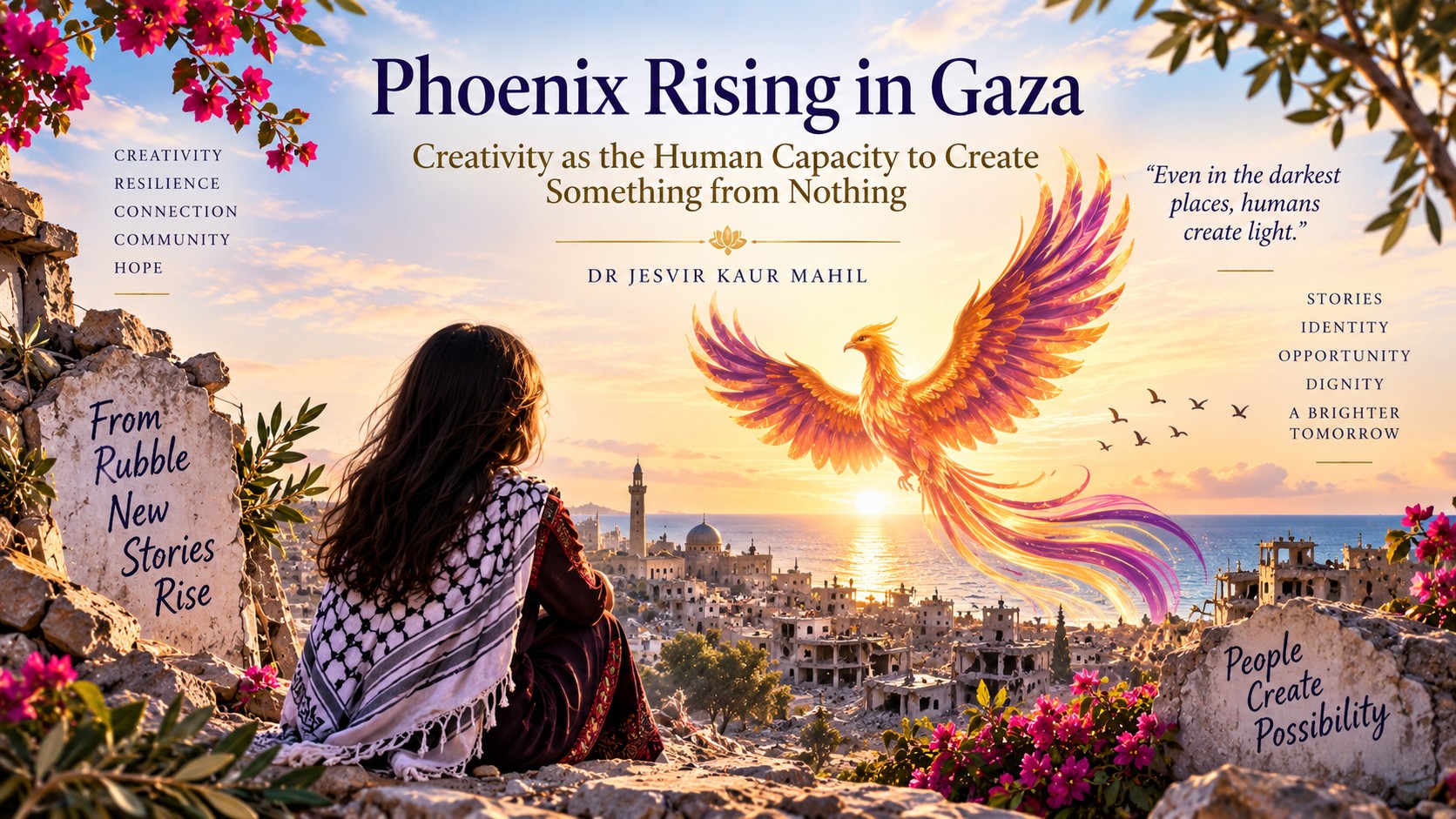
What does creativity mean when almost everything has been taken away? When homes are destroyed, families displaced, livelihoods interrupted and futures rendered profoundly uncertain, creativity can appear to be a luxury. Phoenix Rising in Gaza has led me towards a very different understanding: under conditions of war, displacement and genocide, creativity can become elemental — the human capacity to create connection, community, identity, livelihood, stories, meaning and hope where these possibilities appear to have been destroyed. In these circumstances, creativity becomes closely connected with survival.
When homes have been destroyed, families displaced, livelihoods interrupted, communities fragmented and the future rendered profoundly uncertain, creativity can sound like an indulgence — something associated with art, innovation or self-expression in more comfortable circumstances.
My ongoing Phoenix Rising in Gaza project has led me towards a very different understanding.
Under conditions of war, displacement and genocide, creativity can become elemental. It is not simply about producing something original. It can become the human capacity to create something where there appears to be nothing:
to create connection across destroyed geography;
community after displacement;
livelihood when established economic structures have collapsed;
identity when familiar places have been lost;
stories where people risk being reduced to statistics;
and hope when circumstances offer very little reason for optimism.
In these circumstances, creativity becomes closely connected with survival.
One Palestinian participant in the project expressed this with extraordinary clarity:
“Creativity is a must because you are surviving… you must find a way to replace what is missing in your life.”
That statement has become increasingly important to my understanding of Phoenix Rising in Gaza.
Perhaps creativity is most powerful not when we have abundant resources with which to create, but when what we need does not yet exist and somehow has to be brought into being.
Phoenix Rising in Gaza is an ongoing autoethnographic and relational research project emerging from sustained online conversations between myself and international friends in Gaza, Egypt, Turkey, the United Kingdom and elsewhere.
The project began in July 2024. By February 2025, I had conducted 20 discussions involving 20 participants, including four Palestinians from Gaza, generating approximately 340 pages of transcript.
My initial thematic analysis identified seven interconnected themes:
The inquiry has continued to develop. My more recent conference abstract describes over 35 recorded discussions conducted across the two-year period from July 2024 to 2026.
Increasingly, I have come to understand the project not simply as research about Gaza, but as a relational space in which conversation itself can become an ethical practice of connection, listening, witnessing and shared meaning-making.
The visual work accompanying the project captures this development particularly powerfully. One of the 2026 images describes “Connection is Life”, presenting connection simultaneously as a survival strategy, protection of memory, resistance to dehumanisation, knowledge creation, a pathway to hope and collective healing.
Another depicts digital co-presence as bridge building, with online conversations becoming not merely a way of collecting research data, but spaces in which people see, hear and support one another across physical separation.
This has changed the way I think about creativity.
I do not use “creating something from nothing” literally.
Nobody creates from an absolute vacuum. People carry memories, knowledge, relationships, cultural inheritance, imagination, faith, skills and histories even when material resources have been devastated.
What interests me is the capacity to take what remains and recombine it into something that did not previously exist.
A destroyed home cannot simply be replaced by imagination.
A lost family member cannot be recreated.
Trauma cannot be wished away through positive thinking.
Creativity must never be romanticised in ways that diminish the reality of destruction.
Yet human beings continue to ask:
What is still possible with what remains?
That is where creativity becomes extraordinary.
A conversation can become a community.
A memory can become a story.
A story can become a form of resistance.
A cultural symbol can become a business.
A digital connection can become a bridge.
A shared meal can recreate a sense of home.
An idea can generate income.
A relationship can sustain hope.
A testimony can enter the public record.
These are creative acts because they bring into existence possibilities that the immediate material environment appears to deny.
Much of what is conventionally described as creativity takes place within relatively resource-rich environments.
Organisations create innovation labs. Universities provide workshops. Businesses establish creative teams. People are given materials, technology, time and physical spaces in which to generate ideas.
But what happens when the environment is not enabling creativity but actively hostile to human flourishing?
One of the most important insights emerging from Phoenix Rising in Gaza is that severe constraint does not necessarily eliminate creativity.
Sometimes it changes its purpose.
Creativity moves from:
What could I make?
towards:
What must we somehow make possible?
The February 2025 analysis identified creativity and entrepreneurship as a significant theme precisely because participants were using creativity to adapt to displacement, maintain connections with Palestinian identity and attempt to create sustainable livelihoods.
This is not creativity as an optional enhancement to life.
It is creativity mobilised because established routes to living have been disrupted.
One of the most painful themes in the conversations concerns home.
For people displaced from Gaza, the destruction or loss of a physical home is not merely the loss of a building. Home contains memory, relationships, identity, familiarity and connection with land.
One participant said:
“I need something that will connect me with my history, with my country, with my environment.”
My subsequent visual analysis developed this idea as “Home Beyond Geography.” It distinguishes between home for the body, the heart, the mind and the spirit. The accompanying interpretation recognises that although physical homes can be bombed, emotional and relational homes can still be rebuilt.
This does not make the destruction of physical homes less significant.
It demonstrates something different.
When one form of home is destroyed, people may creatively construct other forms of belonging capable of carrying them through displacement.
Home can temporarily exist:
In a photograph.
In food.
In language.
In conversation.
In another Palestinian’s recognition of a shared experience.
In a digital community spanning countries.
These are not substitutes for justice, safety or the right to return home. But they can become ways of preserving continuity when continuity itself is under threat.
This leads to another important dimension of creativity: remembering.
Memory might initially appear to be the opposite of creativity. Memory looks backwards; creativity appears to make something new.
Phoenix Rising in Gaza suggests that they can be inseparable.
The project’s visual work describes “Memory as Resistance.” Food, homes and neighbourhoods, businesses and brands, language, stories and narratives become “memory carriers.”
Under conditions of dispossession, remembering is presented not simply as nostalgia but as a refusal to allow identities and histories to disappear.
This creates an important relationship:
Memory → Story → Identity → Creation → Continuity
We create the future partly from materials carried from the past.
A traditional pattern incorporated into a contemporary product is therefore more than decoration.
A story about a neighbourhood that no longer physically exists does more than describe the past.
A Palestinian brand can carry history, land and cultural identity into a new economic and geographic context.
Creativity becomes a means through which memory acquires new form.
One participant described a Palestinian brand as something that represented identity and connected Palestinians with their land and their souls. The aspiration extended beyond selling a product. It included creating a community capable of supporting Palestinians, particularly young people in Gaza.
This has led me to think about entrepreneurship as relational reconstruction.
Enterprise can certainly generate income, but within the context of displacement and destruction its significance can extend much further.
A business can:
preserve cultural identity;
tell a story;
connect people across a diaspora;
create economic resilience;
build relationships and solidarity;
and direct resources towards a community.
In this sense, entrepreneurship can become part of reconstruction even before physical reconstruction is possible.
People can begin rebuilding socially, culturally and economically while their material environment remains profoundly unstable.
This produces a powerful principle at the heart of the project:
Destruction attempts to reduce possibility. Creativity generates possibility again.
A creative enterprise therefore need not be understood only in terms of products, markets or profit. It can simultaneously become a vehicle for livelihood, cultural continuity, storytelling, dignity, connection and collective possibility.
The research process itself has also become a form of creativity.
Participants in Phoenix Rising in Gaza are physically separated from me and from one another. We have joined conversations from Gaza, Britain, Egypt, Turkey and elsewhere, sometimes thousands of miles apart.
Yet technology enables us to create a space that does not exist geographically.
A screen becomes a meeting place.
A conversation becomes a bridge.
My 2026 visual analysis describes this as digital co-presence as bridge building. From this perspective, online conversations are not merely tools for collecting research data. They can become sites of relationship and community formation.
There is no shared physical room. There is no building in which everybody gathers.
Yet something real can be created between us.
We listen.
We remember.
We exchange ideas.
We witness.
We sometimes disagree.
We care.
We make meaning together.
The space becomes real because of what happens between us.
This has important methodological implications. The research method itself can become part of the phenomenon being explored. The interview becomes more than a mechanism for extracting information.
The interview can become a bridge.
The conversation can become a community.
Creativity therefore exists not only in what participants describe, but in the relationships and spaces that we create together through the research itself.
Phoenix Rising in Gaza has also challenged conventional distinctions between the researcher and the researched.
I am not a detached observer extracting information from participants. My own positionality, experiences and relationships inevitably influence the questions I ask, the connections I make and the way I hold the conversational space.
Within this project, I increasingly understand my role as a diasporic bridge-builder, listener across borders, co-thinker, elder educator, witness and relational participant.
My own family histories of migration, partition and rebuilding also influence how I encounter stories of displacement, identity, belonging and reconstruction.
Knowledge therefore emerges through relationship.
This understanding is central to the methodological approach I have developed through APS: Autoethnography, Public Engagement and Self-Publishing.
APS brings together three perspectives:
I — Autoethnography and lived experience
We — Public engagement, dialogue and collective meaning-making
They — Publication and engagement with wider and expert knowledge
These perspectives do not operate as a simple linear sequence. They interact recursively as reflection generates dialogue, dialogue generates new understanding, publication creates further public engagement, and those responses can feed back into renewed reflection and inquiry.
Within Phoenix Rising in Gaza, this means knowledge is not simply extracted from participants, analysed by a researcher and then published as a finished product.
It is continually co-created through conversations, relationships, reflection, public engagement and further inquiry.
In this sense, APS can help create a voice for those who might otherwise remain silent or be silenced, while also requiring continual reflection on whose voice is being represented, by whom, and for what purpose.
The knowledge emerging from Phoenix Rising in Gaza is therefore not mine alone.
It has been generated through the relationships and conversations that made its creation possible.
One of the most troubling dimensions of genocide is dehumanisation.
People can become reduced to categories, numbers, statistics or abstractions. Individual lives, relationships, histories, aspirations and personalities can disappear behind the scale of destruction.
Creativity can work in the opposite direction.
A story restores particularity.
A name restores identity.
A photograph restores a face.
A memory restores history.
A conversation restores relationship.
An entrepreneurial idea restores agency.
Humour restores ordinary humanity.
Art restores imagination.
Connection restores recognition.
My visual analyses of Phoenix Rising in Gaza repeatedly return to this relationship between connection, humanity and dignity. Connection can resist dehumanisation because it enables people to encounter one another not simply as distant populations or statistics, but as human beings with names, memories, relationships, ideas, humour, creativity and hopes for the future.
Creativity therefore becomes more than an ability to make things.
It can become an assertion of continued human presence:
I am still here.
We are still here.
We can still imagine.
We can still create.
Under conditions that threaten to erase identity, agency and possibility, the act of creating can itself become a refusal to be reduced to silence, anonymity or nothingness.
The image of the phoenix rising from the ashes has become a powerful metaphor within this project.
One participant expressed the idea directly:
“We will rise again and build ourselves again… the ability for this exists in our blood as Palestinians.”
There is enormous power in this expression of determination. Yet the phoenix metaphor must also be handled with care.
There is a danger in narratives of resilience when survival becomes something admired without sufficient attention to the conditions that made such extraordinary resilience necessary.
People should not have to demonstrate exceptional creativity simply to secure the necessities of everyday life.
The phoenix must therefore never imply that destruction is acceptable because people will rebuild.
Nor should resilience become an invitation for those outside the experience to celebrate human strength while failing to confront the suffering, injustice and destruction that people are being required to survive.
My more recent analysis has therefore moved towards the idea of:
renewal within trauma rather than recovery after trauma.
This distinction matters.
The phoenix does not wait for peace before rising. People create relationships, livelihoods, stories, communities and possibilities while their wounds remain open and their circumstances remain profoundly uncertain.
This is not a story in which trauma has ended and recovery has begun.
The fire is still burning.
And people are nevertheless creating.
The power of the phoenix lies not in romanticising the fire, but in recognising the human capacity to continue creating within conditions that should never have been imposed upon them.
Earlier in the project, I reflected:
“Once the optimism is destroyed, then creativity can’t be born… it tends to be born out of optimism.”
As the inquiry has developed, however, I have begun to distinguish more carefully between optimism and hope.
Optimism anticipates that circumstances will improve.
Hope can exist even when there is very little evidence that immediate circumstances are going to improve.
My later visual analysis describes “Hope as Collective Discipline.” From this perspective, hope is not simply a positive feeling and it is not naïve optimism.
It is actively maintained.
It can emerge through children, humour, imagining the future, family gatherings, helping other people and continuing to share stories.
Hope can therefore become a form of creative work.
People imagine a future that does not yet exist and continue to act, however modestly, as though some part of that future remains possible.
They educate children.
They tell stories.
They build businesses.
They maintain relationships.
They help neighbours.
They preserve photographs.
They remember recipes.
They laugh.
They talk about returning.
They imagine rebuilding.
Through such acts, people create fragments of the future within the present.
Hope, understood in this way, is not a denial of suffering.
It is the creative refusal to surrender the possibility of a future.
The different strands of Phoenix Rising in Gaza lead me towards a deeper understanding of creativity.
Perhaps the opposite of creativity is not simply the absence of art, innovation or new ideas.
At its deepest level, creativity can become a refusal of nothingness.
Where violence creates absence, creativity creates presence.
Where displacement creates separation, people create connection.
Where destruction creates rubble, people imagine rebuilding.
Where dehumanisation creates anonymity, storytelling restores identity.
Where isolation creates silence, conversation creates community.
Where economic destruction removes livelihoods, entrepreneurship searches for new possibilities.
Where despair suggests there is no future, hope insists that a future can still be imagined.
This does not mean that creativity can solve everything.
Creativity cannot stop bombs.
It cannot resurrect those who have been killed.
It cannot restore a destroyed childhood.
It cannot substitute for political action, humanitarian protection, accountability or justice.
We must not ask creativity to carry burdens it cannot carry.
But creativity can help human beings remain human within conditions that threaten their humanity.
Perhaps that is why the capacity to create becomes so significant when so much else has been destroyed.
Destruction produces absence. Creativity insists that something can still be brought into being.
The people contributing to Phoenix Rising in Gaza are not simply waiting passively for some future moment when rebuilding can begin.
They are already creating.
Connections.
Communities.
Businesses.
Stories.
Memories.
Relationships.
Knowledge.
Meaning.
Possibilities.
Hope.
This is why I increasingly understand the title Phoenix Rising in Gaza not simply as a metaphor for some future moment after destruction has ended.
The rising is already taking place through countless small, relational and creative acts.
Not after the fire.
Within it.
The question with which this article began was:
What does creativity mean when almost everything has been taken away?
Perhaps the question can now be reframed:
When so much has been destroyed, what can human beings still create from what remains?
The conversations within this project offer many different answers.
But perhaps the most important is this:
When the external environment offers almost nothing from which to construct a future, human beings can still create relationships, stories, meanings, ideas and possibilities together.
That does not erase the destruction.
It refuses to allow destruction to have the final word.
Phoenix Rising in Gaza is an ongoing co-creative research project. This article represents a moment within a continuing inquiry rather than a set of final conclusions.
The project began through online conversations in July 2024 and has developed from an initial thematic analysis of 20 discussions into more than 35 recorded conversations across 2024–2026.
The methodological approach is APS — Autoethnography, Public Engagement and Self-Publishing — through which I work recursively across three interconnected perspectives:
I — lived experience, reflection and autoethnography
We — dialogue, relationship and public engagement
They — published knowledge, wider perspectives and engagement with the public domain
Within APS, self-publishing is not understood simply as the final stage of disseminating completed research. It can itself become a methodological act: ideas are shared publicly, encounter the experiences and perspectives of others, and generate questions and understandings that feed back into further reflection and inquiry.
In this sense, APS seeks to make scholarship a form of communicative action through which socio-cultural capital can be co-created, bridges can be built and identities can be transformed.
The visual, written and conversational materials generated through Phoenix Rising in Gaza are therefore interconnected elements of an evolving relational inquiry.
My own role within this work is not that of a detached observer. I participate as a listener, witness, co-thinker, diasporic bridge-builder and relational participant, while remaining reflexive about the responsibilities and limitations of that position.
The knowledge emerging from this project is not mine alone. It has been generated through relationships and conversations with the people who have contributed their experiences, reflections and ideas.
This article is therefore not the end of the inquiry. It is a contribution to an ongoing conversation from which further knowledge may emerge.
Dr Jesvir Kaur Mahil (September 2026)
© 2026 Dr Jesvir Kaur Mahil. All rights reserved.
This article may be shared by linking to this webpage. Please do not reproduce or republish the text without permission.