Dr Jesvir Kaur Mahil · September 2026
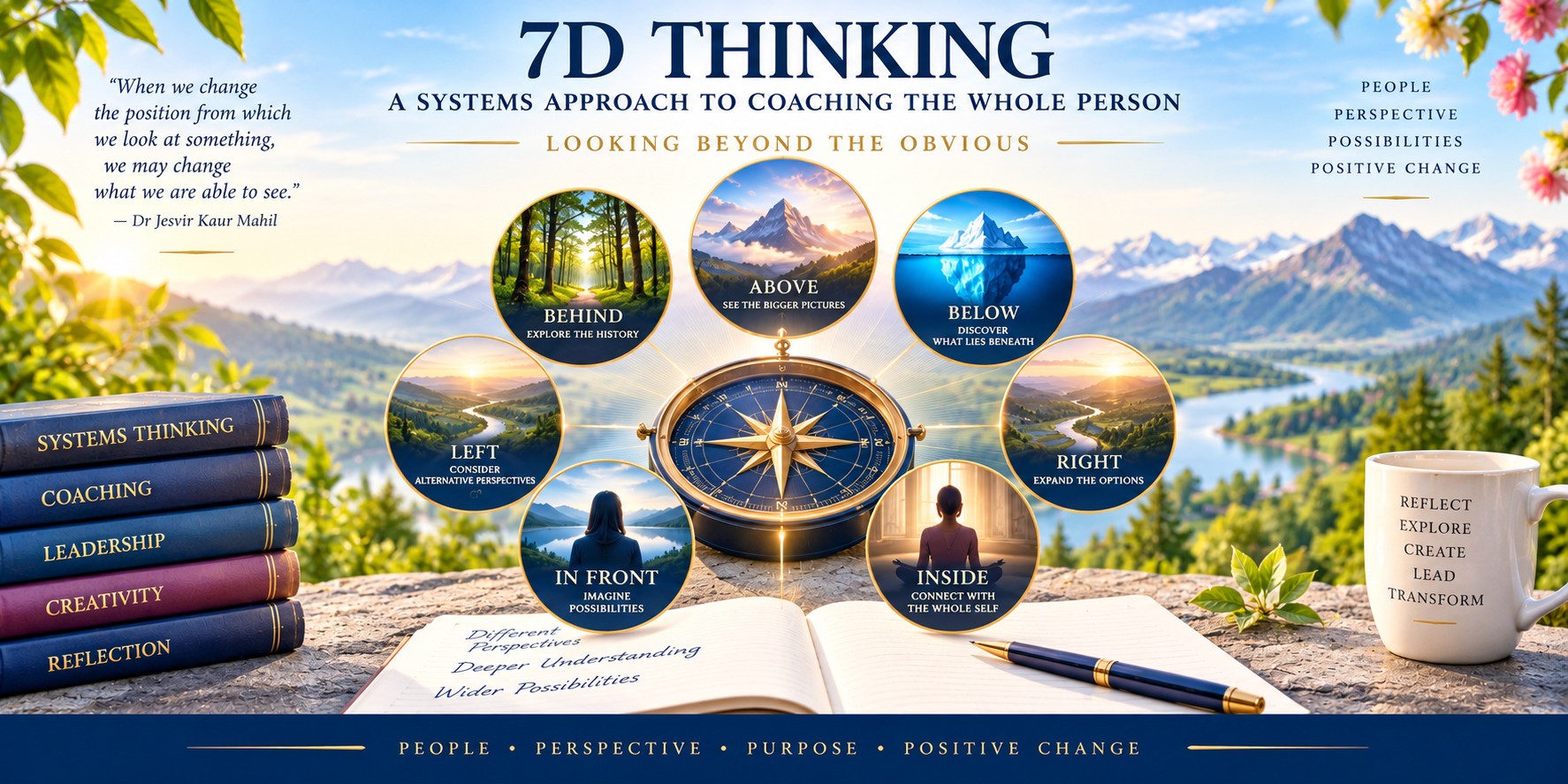
7D Thinking is a Systems Thinking approach to coaching the whole person. Rather than assuming that the problem presented at the beginning of a coaching conversation is necessarily the problem that needs to be solved, the framework invites us to examine a situation from multiple perspectives.
By looking Above, Below, Behind, in Front, to the Left, to the Right and Inside, we can expand what we see, connect patterns and discover different possibilities for understanding and action.
When people come to coaching, they often arrive with a question. Should I apply for this promotion? Why am I struggling in this role? What should I do next? Why does this situation keep recurring? What does success mean to me now?
The temptation is to move quickly towards an answer.
My 7D Thinking Coaching Framework takes a different approach. Instead of assuming that the problem presented at the beginning of a coaching conversation is necessarily the problem that needs to be solved, 7D Thinking encourages us to look at the situation from multiple perspectives before deciding what it means or what to do about it.
I developed the framework through the convergence of my work in Systems Thinking, creativity, education, leadership, coaching and autoethnography. I originally used 7D Thinking to structure my own critical reflection and subsequently taught it to senior leaders as an alternative way of approaching complex professional situations.
At its heart is a simple proposition:
When we change the position from which we look at something, we may change what we are able to see.
And when we see differently, different possibilities for action can emerge.
One of the inspirations for 7D Thinking was the well-known Buddhist story of the blind men and the elephant.
Each person touches a different part of the elephant and consequently reaches a different conclusion about what the elephant is. One encounters something resembling a wall, another a rope, another a tree and another a spear.
Each perspective contains some truth. None contains the whole truth.
I have long been interested in this story because it captures an important principle of Systems Thinking. Complex situations cannot necessarily be understood by examining one component in isolation.
In my Senior Fellowship reflective work, I contrasted 7D Thinking with established reflective approaches such as those associated with Kolb, Gibbs and Driscoll. My purpose was not to suggest that these models have no value. Rather, I wanted a framework more explicitly concerned with the synthesis of multiple perspectives, including dimensions that may remain unknown, invisible or unconscious.
This concern also emerged from my doctoral research, where I explored limitations in our capacity to account for the invisible and unconscious drivers underlying observable behaviour.
The resulting framework asks us metaphorically to look:
Above · Below · Behind · In Front · Left · Right · Inside
These are not seven steps that have to be completed mechanically in sequence. They are seven perspectives from which a coach and coachee can investigate a situation.
The seven dimensions of 7D Thinking are not intended as a linear sequence. They provide different positions from which a situation can be examined, allowing the coach and coachee to move between wider systems, underlying influences, history, future possibilities, relationships, material realities and the inner world of values, emotions and meaning.
Above invites us to rise metaphorically above the immediate problem and adopt a bird’s-eye or ecological perspective.
The central question is:
Where are we positioned in this?
From ground level, we may see an individual disagreement, disappointing result or immediate obstacle. From above, we may begin to see the wider system: organisations, communities, cultures, institutions, economic conditions, social structures and relationships.
This perspective is particularly important in coaching because people can easily internalise problems whose causes are partly systemic.
The wider perspective therefore asks us to consider not simply What am I doing? but:
What system am I part of, and how am I positioned within it?
In the original framework, I describe this explicitly as an “ecological perspective from a bird’s eye point of view.”
If Above takes us outward, Below takes us underneath.
The central question becomes:
Which underlying forces are driving this?
Here I use symbols, images, metaphors and archetypes to explore influences that may not initially be visible or consciously articulated.
This dimension is closely associated with the iceberg metaphor I use in Systems Thinking. What we observe above the waterline may constitute only a small proportion of what is happening. Beneath it may lie assumptions, histories, beliefs, fears, identities and other forces shaping behaviour.
In my earlier teaching of the framework, I explicitly described this territory as involving the “unknown, invisible and interior.”
A useful coaching question is therefore:
When you think about this situation, what image, symbol or metaphor comes to mind?
The answer can sometimes reveal something that a conventional problem-solving question does not.
Every present has a history.
The Behind dimension therefore asks:
How did we get here?
It encourages the coachee to connect relevant dots and look for patterns.
That distinction matters. History is more than a chronology of events. From a Systems Thinking perspective, we are interested in relationships between events and in patterns that recur through time.
A person considering a difficult career decision, for example, might discover that what initially appears to be an isolated problem resembles choices they have encountered repeatedly.
This is also where my autoethnographic practice connects particularly strongly with 7D Thinking. Personal history is not simply background information. Reflecting critically upon it can help us understand how earlier experiences influence the meanings we attach to present situations.
The question therefore develops from:
What happened?
to:
When you connect the relevant dots, what patterns do you notice?
Reflection should not leave us permanently looking backwards.
Front represents vision, aspiration and possibility.
Rather than simply asking What is your goal?, my coaching framework poses a more celebratory question:
Where and when is the next milestone to be celebrated — and who will you celebrate with?
The language is deliberate. A milestone is tangible enough to imagine, while celebration reminds us that achievement has human and emotional significance.
This dimension therefore shifts coaching from analysing the past towards imagining a desirable future.
It also raises an important question:
What if you changed the milestone?
Sometimes people work extremely hard towards goals that no longer represent what they genuinely value. Good coaching should provide permission to examine the destination as well as the route.
Left represents social values and relationships.
It asks:
Who are the most important relationships in this?
My original framework associates this dimension with values including love, sharing, loyalty, trust, happiness, inspiration and altruism.
This matters because conventional approaches to career and leadership development can overemphasise individual achievement.
Human beings do not make decisions in isolation.
A promotion might increase status while reducing time with family. A career move may bring greater income while separating someone from a valued community. An apparently successful leadership decision may damage trust.
7D Thinking therefore asks:
Which relationships deserve my attention?
and also:
Which social values am I currently neglecting?
These questions broaden our understanding of what constitutes a successful outcome.
Relationships and human values matter, but material reality matters too.
Right therefore explores material values and outcomes.
The central question is:
What are the most desirable material outcomes?
In the original framework I included considerations such as survival, comfort, growth, beauty, recognition, celebration and legacy.
This is not an argument for materialism. It is an invitation to be explicit about what we want.
Money matters. Security matters. A comfortable home may matter. Recognition may matter. Creating something beautiful may matter. Leaving a legacy may matter.
The coaching task is not to decide which of these someone ought to value. It is to help them recognise what they actually value, what they are neglecting and what trade-offs their choices may entail.
I have used this principle when coaching senior leaders about promotion. Advancement can bring recognition and power, but it may simultaneously bring less privacy, security or rest. Seeing these potential opportunity costs before making a decision creates greater choice.
The seventh dimension is perhaps the most difficult.
Inside asks:
Why are we paying attention to this?
My framework associates this dimension with the unknown, invisible and intrapersonal realm and with questions of spirit, love, energy and consciousness.
Two assumptions appear in my original coaching notes:
As within, so without.
and
Thinking and feeling are connected.
The coach might therefore ask:
When you think about this, what do you feel?
This creates space to explore the relationship between thought, values, feelings and action, rather than assuming that important decisions are purely rational.
As I developed 7D Thinking further, I became increasingly interested in the distinction between values and emotions.
Values tend to provide relatively enduring principles through which we orient ourselves. Emotions can be much more immediate and changeable.
I therefore began asking:
Are my decisions and actions being driven by my values or by my emotions?
This distinction can be particularly useful when making consequential decisions.
An emotion may provide important information and should not simply be suppressed. But a short-lived emotional state should not necessarily determine a long-term decision.
I describe emotion in the framework metaphorically as “energy in motion” — E-motion. Like wind, emotion itself cannot be seen directly, but its presence can be observed through its effects: our posture, language, gestures, behaviour and interactions with others.
This leads to another coaching question:
Which emotions am I choosing to channel through me, for how long and at what intensity?
The purpose is not to divide emotions simplistically into good and bad. Fear, anger, sadness, curiosity, joy and passion can all communicate something important.
The task is to notice what they are doing.
The exploration of values and emotions led me to think more deeply about behaviour itself.
I developed a related way of looking at the word BeHaviOur:
Be – Have – I – Our
Each part points towards a different aspect of human experience:
Be — identity: Who am I being?
Have — outcomes: What do I want to have or create?
I — the individual: What is my own perspective, agency and responsibility?
Our — the collective: How am I connected with other people and the wider systems of which I am part?
These dimensions do not operate independently. They interact with our perceptions, thoughts, values and emotions.
This creates an important possibility for coaching. If transformations in perception, values or emotions can transform behaviour, and behaviour is interconnected with both individual and collective identity and outcomes, then sustainable change may require us to look beneath the behaviour we initially observe.
The question becomes:
What might I need to perceive differently, value differently or feel differently before different behaviour becomes possible?
Once a situation has been explored through the seven dimensions, I introduce a further ingredient: creativity.
The question “What if?” creates space for possibilities that may not have been visible from the original position.
For example:
What if you shifted your position?
What if you chose a different metaphor?
What if you discovered something different about your history?
What if you changed your next milestone?
What if you invested attention in different relationships?
What if you changed your definition of material success?
What if you changed the energy you brought to the situation?
These questions do more than generate alternative solutions. They can challenge the assumptions through which the problem itself has been constructed.
Creativity therefore becomes integral to 7D Thinking. The purpose is not simply to solve an existing problem more efficiently, but to create the possibility of seeing the situation differently.
A 7D Thinking coaching conversation does not necessarily begin by moving mechanically through each of the seven dimensions.
Instead, I often begin with a question such as:
Since our last conversation, what dots have you connected and what patterns have you seen emerging?
I may then ask:
What is the subject that is most important, interesting and valuable for you to explore today?
The conversation can move between the different perspectives according to what emerges. The seven dimensions provide a framework for exploration rather than a prescribed sequence.
Towards the end of the conversation, I return to the idea of connecting the dots:
If you connect the dots creatively, how does everything you have said relate to the question you brought into the conversation?
The coachee can then identify another question that may be worth carrying forward into further reflection.
This is important because the outcome of coaching does not always need to be a neat answer or immediate solution.
Sometimes the most valuable outcome is a better question.
I have used 7D Thinking with senior leaders and in workshops introducing Systems Thinking at Aston, Birmingham and Loughborough universities.
In my Senior Fellowship account, I recorded how Level 7 apprentices used the framework to support critical reflection. The learners referenced in that account achieved a 100% success rate, with more than 95% achieving Merit or Distinction.
I do not suggest that these outcomes were caused by 7D Thinking alone. Educational achievement is too complex to support such a simple causal claim.
What the experience did demonstrate was that senior professionals could engage productively with a reflective framework that encouraged them to move beyond description and consider patterns, systems, assumptions, perspectives and deeper questions.
Following one Systems Thinking workshop, a participant commented that the session was unlike the lectures they had recently attended and that it had inspired them to try using Systems Thinking in their next assignment.
For me, this captures an important purpose of 7D Thinking:
not to tell people what to think, but to expand how they think.
My wider educational philosophy has often begun with the question:
WHO am I teaching?
rather than only:
WHAT am I teaching?
The same principle applies to coaching.
We are not simply coaching a job title, an isolated behaviour or a problem to be solved. We are coaching a whole human being situated within a complex system.
That person has a history. They have relationships. They live within material realities. They anticipate a future. They participate in wider social and ecological systems. They have thoughts, emotions, values and motivations — some of which may initially be invisible even to themselves.
All of these dimensions interact.
This is why I understand 7D Thinking fundamentally as a Systems Thinking approach to coaching the whole person. Rather than isolating one element and treating it as though it exists independently, the framework invites us to explore relationships, patterns and connections across the person’s experience.
The aim is not necessarily to make complexity disappear.
It is to help us see more of the system within which meaning, choice and action are emerging.
There is an important limitation built into 7D Thinking.
Seven dimensions do not mean that we have achieved a complete view of a person, problem or system.
There will always be things that remain unknown or unnoticed. Other people may hold knowledge that we do not have. Unconscious processes may remain inaccessible to us. The consequences of our choices may also unfold in ways that we cannot predict.
The framework therefore needs to be accompanied by humility.
7D Thinking is intended to expand our field of vision, not to create an illusion that we can see everything.
From a Systems Thinking perspective:
We can expand our field of vision without ever seeing the whole system.
This makes curiosity particularly important. Rather than assuming that we have arrived at the definitive explanation, we can continue asking:
What might I still not be seeing?
The unknown is therefore not a failure of the framework. It is a reminder that human beings and the systems within which we live are complex, dynamic and never entirely knowable.
7D Thinking has developed into more than a framework for reflection. I understand it as a framework for perspective, possibility and transformation.
It invites us to move beyond the immediate problem and look outwards to the wider ecology, beneath observable behaviour, backwards towards history and patterns, forwards towards vision and possibility, sideways towards relationships and material realities, and inwards towards values, emotions, identity and meaning.
We can then connect the dots between these different perspectives.
The objective is not to produce seven separate answers. It is to develop a richer understanding of the whole situation and the relationships between its different dimensions.
Changing perspective does not guarantee that a problem will disappear. But it may change what we notice, the questions we ask and the possibilities we are able to imagine.
This returns us to the central proposition of 7D Thinking:
When we change the position from which we look at something, we may change what we are able to see.
And when we see differently, different possibilities for action can emerge.
The coaching conversation can therefore end with a deceptively simple question:
What might become possible if you looked at this differently?
I developed 7D Thinking through my research and professional practice in Systems Thinking, creativity, education and coaching.
An early version of the framework was used in my Senior Fellowship application during 2022–23, where I connected it with my doctoral research and autoethnographic reflection. I subsequently developed it into a more detailed coaching approach incorporating the seven perspectives, values and emotions, metaphors, creative “What if?” questions and the BeHaviOur model.
I regard 7D Thinking as evolving practitioner research rather than a static model. Its purpose is not to prescribe a fixed sequence of questions, but to provide different positions from which people can examine their experiences, connect patterns, challenge assumptions and generate new possibilities.
I therefore invite coaches, educators, leaders and learners not simply to apply the framework, but to adapt it, connect it, question it and continue learning through it.
Dr Jesvir Kaur Mahil (September 2026)
© 2026 Dr Jesvir Kaur Mahil. All rights reserved.
This article may be shared by linking to this webpage. Please do not reproduce or republish the text without permission.