Dr Jesvir Kaur Mahil · September 2026
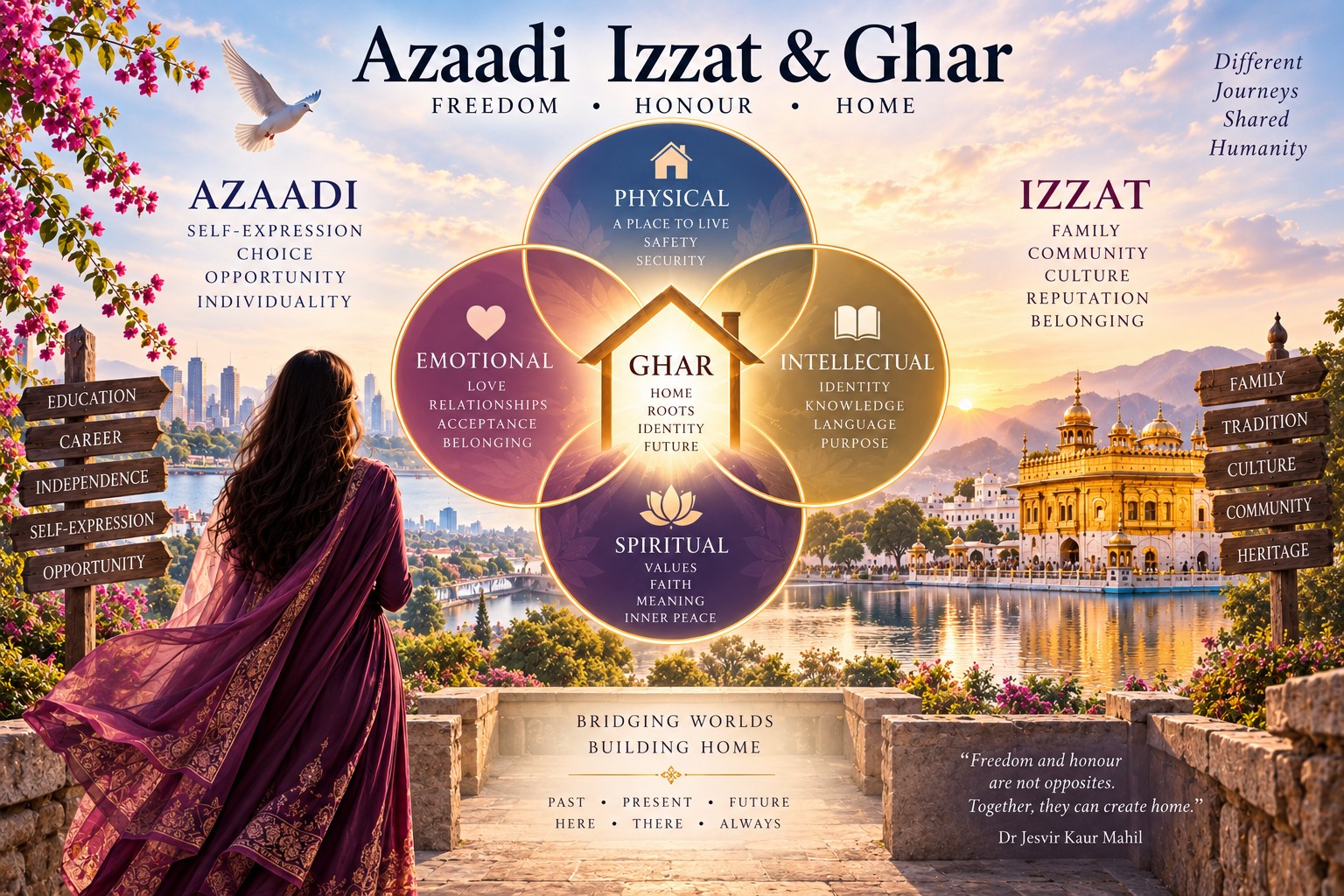
Azaadi (freedom), Izzat (honour) and Ghar (home) are deeply interconnected. Home is more than a physical place: it can be experienced emotionally through relationships and belonging, intellectually through language, identity and ways of understanding the world, and spiritually through values, faith, meaning and inner connection. Drawing upon conversations with members of the Sikh diaspora, this article explores what happens when freedom and honour are negotiated across these different dimensions of home — and how changing cultural, generational and gender expectations reshape our understanding of where, and how, we belong.
The concepts of Azaadi (freedom), Izzat (honour) and Ghar (home) can appear, at first, to describe different aspects of human experience.
Azaadi concerns our capacity to choose, act and express ourselves.
Izzat concerns honour, dignity, reputation and our relationships with family and community.
Ghar is commonly understood as home.
Yet the conversations underpinning this research suggest that these concepts cannot easily be separated. Freedom is exercised within relationships. Honour is constructed through cultural and social expectations. And home is not simply the physical setting in which these tensions occur: it is one of the places in which identity, belonging, freedom and honour acquire meaning.
The research drew upon 23 discussions with members of the Sikh diaspora in the UK, Canada, New Zealand and USA during 2024. Participants reflected upon cultural identity, intergenerational expectations, gender roles, family structures, historical experience, spirituality and the challenges of navigating different cultural worlds.
Taken together, these conversations invite us to think about Azaadi, Izzat and Ghar as parts of an interconnected system rather than isolated concepts.
The central question therefore becomes not simply whether we choose freedom or honour, but:
How might we create forms of home in which freedom, honour and belonging can coexist?
The discussions suggest that home cannot be understood only as a physical location.
For people living across cultures, countries and generations, Ghar may operate simultaneously on several interconnected planes.
Physical home concerns place, shelter, safety and the material environments in which we live.
Emotional home emerges through love, relationships, acceptance and a sense of belonging. We may occupy a physical home while nevertheless experiencing emotional distance, fragmentation or loneliness.
Intellectual home concerns the languages, ideas, histories and cultural frameworks through which we understand ourselves and the world. Language is particularly significant here. As one participant observed:
“Language is the core of our identity; if we lose our language, we lose ourselves.”
Spiritual home concerns faith, values, meaning, inner peace and our connection with something deeper than immediate material circumstances. Participants emphasised the importance of spiritual grounding when navigating cultural and personal change. One reflection captured the consequences of disconnection particularly strongly:
“When we are disconnected from our roots and spirit, we experience a deep loneliness.”
These planes are not independent compartments. They interact.
A person may be physically secure while feeling emotionally displaced. They may achieve intellectual and professional success while experiencing cultural disconnection. They may live thousands of miles from an ancestral homeland while sustaining a profound emotional or spiritual sense of home.
This suggests that Ghar is simultaneously a place, a relationship, a way of knowing and a state of belonging.
The question of home therefore becomes more complex:
What enables us to feel at home physically, emotionally, intellectually and spiritually — and what happens when these dimensions become disconnected from one another?
A central theme within the discussions was the different cultural meanings attached to Azaadi — freedom.
Participants contrasted Western understandings of freedom, often associated with self-expression, personal decision-making and independence, with cultural traditions in which individual choices are more closely situated within family and community expectations.
As one participant explained:
“In the West, freedom means dressing how you want, making decisions for yourself. But in Punjab, many of these things are predetermined by family and society.”
Another reflection captured the underlying difference between individual and collective orientations:
“The concept of personal versus collective is deeply ingrained in our culture; we think more about ‘we’ rather than ‘I.’”
The tension is therefore more complex than simply having or not having freedom.
Azaadi raises questions about who is understood to have the authority to choose, how individual choices affect others, and how much freedom a person can exercise without threatening relationships, cultural expectations or collective identity.
These questions become particularly significant across generations. Younger people may have greater educational, professional and economic opportunities and may place greater emphasis upon choosing their own careers, relationships and ways of living. At the same time, those choices can challenge expectations inherited from earlier generations.
This creates a continuing negotiation between:
I and we.
Choice and responsibility.
Independence and belonging.
Azaadi, therefore, does not necessarily require freedom from relationships or culture. A more generative question may be whether it is possible to create freedom within relationships — forms of autonomy that allow individuals to develop and make meaningful choices without assuming that connection, responsibility and belonging must disappear.
If Azaadi draws attention towards individual freedom and choice, Izzat — honour — draws our attention towards relationships and the collective.
Within the discussions, Izzat was closely associated with family reputation, community relationships and social standing. An individual’s actions could therefore carry meaning beyond the individual because they might also affect how a family or community was perceived.
Yet the conversations also showed that the meaning of Izzat is not static.
One participant observed:
“A family that is benevolent, philanthropic, and engaged in community work has a strong Izzat.”
This understanding moves honour beyond conformity or reputation alone. It connects Izzat with how people contribute to others and to their community.
Participants also reflected upon changing measures of status. In earlier generations, having a large family might itself have signified status, whereas contemporary measures can include career achievement and financial independence.
These changes become particularly significant when we consider gender. Participants described how women now have greater access to education, careers, financial independence and personal choice, while simultaneously continuing to encounter expectations that they should maintain the honour of the family.
As one participant put it:
“Women now have more opportunities, but they are still expected to maintain Izzat for the family.”
This creates an important tension. If honour is understood primarily as compliance with inherited expectations, it can constrain Azaadi. But if Izzat is understood more broadly through dignity, contribution, responsibility and mutual respect, freedom and honour need not necessarily be opposites.
The question then becomes:
Can Izzat evolve in ways that honour both the individual and the collective?
The relationship between Azaadi and Izzat becomes particularly visible when we consider changing expectations of women.
Participants described how greater access to education, employment and financial independence is enabling women to exercise more autonomy in choosing careers, partners and ways of living. These changes can challenge traditional expectations of duty, sacrifice and family responsibility.
As one participant observed:
“The older generation sees Izzat as a family matter, but younger individuals are now asserting their own identities and choosing their own paths.”
Another reflected:
“With financial independence, women are asserting their individual identities rather than just being seen as part of the collective.”
These changes are significant because they alter not only the choices available to individual women, but also the relationships and structures within Ghar.
When women have greater economic independence and decision-making power, assumptions about who provides, who cares, who decides and who carries responsibility for family honour can begin to change.
Yet greater freedom does not automatically remove older expectations. Participants described a continuing tension in which women may experience increased opportunities while simultaneously being expected to uphold traditional notions of Izzat.
The relationship between freedom and honour therefore needs to be considered alongside power.
Who is permitted Azaadi?
Whose behaviour is understood to affect Izzat?
Who carries responsibility for maintaining Ghar?
And whose aspirations are expected to be adjusted in order to preserve it?
These questions suggest that the evolution of home is not simply about changing household arrangements. It involves renegotiating agency, responsibility, identity and belonging across generations and genders.
For members of diaspora communities, questions of Azaadi, Izzat and Ghar are also negotiated across different cultural worlds.
Participants discussed the challenge of maintaining cultural identity while living within societies shaped by different values, expectations and ways of life. This produced an important distinction between assimilation and integration.
Assimilation can imply leaving aspects of one cultural identity behind in order to conform to another. Integration creates the possibility of maintaining meaningful connections with heritage while also participating fully in the society in which we live.
As I reflected during the discussions:
“We must build bridges between cultures rather than live in two separate worlds.”
Language emerged as particularly important to this process. One participant observed:
“Language is the core of our identity; if we lose our language, we lose ourselves.”
Language is more than a practical means of communication. It can carry memory, history, relationships, cultural meanings and ways of understanding the world.
This brings us back to the idea of home existing on different planes.
A person can be physically at home in one country while maintaining powerful emotional, intellectual or spiritual connections with another. Equally, someone may be physically surrounded by family and community yet feel that important aspects of their identity cannot be expressed.
For diaspora communities, Ghar may therefore be neither simply “here” nor “there.” Home can be constructed through relationships between places, languages, generations and cultural traditions.
The challenge is not necessarily to choose between identities, but to find ways of creating connection without erasure and integration without fragmentation.
Ideas about freedom, honour and home do not develop only in the present. They can also carry the imprint of historical experience and collective memory.
Participants reflected particularly upon the legacy of Partition in 1947 and the ways in which experiences of violence, displacement, honour and survival may continue to influence cultural expectations.
As one participant observed:
“Partition forced families to make impossible choices in the name of honour.”
Another reflection emphasised the continuing gendered consequences of that history:
“The trauma of the past continues to dictate expectations for women today.”
These reflections invite us to consider how experiences belonging to one historical period may continue to shape assumptions and behaviours in later generations.
This is particularly significant when thinking about Ghar. Historical displacement can transform home from something that appears permanent and secure into something that can be lost, left behind, remembered or recreated elsewhere.
Home may therefore exist not only in physical space but also through memory, family narratives, cultural practices and inherited understandings of belonging.
Seen in this way, contemporary negotiations between Azaadi and Izzat do not occur on an empty landscape. They take place within cultural histories that may contain experiences of migration, survival, sacrifice, loss and resilience.
Recognising those histories does not mean assuming that the past must determine the present. Rather, it allows us to ask how inherited expectations have developed and whether they continue to serve individuals, families and communities today.
The meaning of Ghar is also changing as family structures and expectations evolve.
Participants reflected upon the shift from larger, multigenerational households towards more varied family arrangements, including nuclear families. These changes affect not only where people live, but also who is expected to care for whom and what responsibilities different generations are assumed to carry.
One participant observed:
“Family expectations have changed—grandparents are no longer assumed to be caretakers.”
Another reflected:
“We must recognize that with modern choices come new responsibilities and expectations.”
These changes illustrate an important relationship between Azaadi and Ghar.
Greater personal freedom can create new possibilities for younger generations, but older generations may also seek greater independence. Grandparents have aspirations, identities and choices of their own. Azaadi cannot therefore be understood as something belonging only to the young.
As family roles change, assumptions about care, duty, sacrifice and responsibility may also need to be renegotiated.
This raises important questions:
What do we owe one another within Ghar?
When does care express love and belonging, and when does expectation begin to restrict another person’s freedom?
How can responsibilities be shared without assuming that particular family members must sacrifice their own aspirations?
The changing family is therefore not necessarily evidence that Ghar is becoming less important. It may instead require us to rethink what home means when freedom, responsibility and belonging are negotiated rather than simply inherited.
The discussions also highlighted another dimension of Ghar that cannot be reduced to geography, family structure or material security: spiritual home.
Participants emphasised the importance of faith, inner peace and spiritual grounding in maintaining personal stability while navigating cultural and social change.
One reflection captured the experience of disconnection particularly powerfully:
“When we are disconnected from our roots and spirit, we experience a deep loneliness.”
Another participant observed:
“Spiritual alignment helps navigate cultural and personal challenges with greater clarity.”
These insights suggest that belonging is not created solely by being physically surrounded by familiar people, places or cultural practices.
We may possess a physical home and still experience emotional or spiritual fragmentation.
Conversely, spiritual grounding can provide a sense of continuity and belonging even when our physical circumstances, relationships or cultural environment are changing.
This adds another dimension to the relationship between Azaadi and Izzat. Freedom is not necessarily only the external capacity to make choices, and honour is not necessarily only the reputation bestowed upon us by others. Both can also be considered in relation to an inner sense of integrity: whether the lives we are creating are aligned with our deepest values, meaning and sense of self.
Ghar can therefore be understood not only as somewhere we inhabit, but as something we may also need to cultivate within ourselves.
Physical, emotional, intellectual and spiritual home are interconnected. When these dimensions become severely misaligned, we may experience alienation or fragmentation; when they become more closely aligned, they can provide a deeper sense of belonging, purpose and wholeness.
The conversations explored in this research reveal that Azaadi, Izzat and Ghar are not fixed concepts. Their meanings are continually negotiated through culture, family, gender, generation, migration, history and spirituality.
Azaadi asks how we can exercise choice, agency and freedom.
Izzat asks how those choices relate to dignity, responsibility, family and community.
Ghar asks where — and how — we experience home and belonging.
Seen together, these concepts reveal a dynamic relationship between the individual and the collective.
The challenge is not necessarily to choose freedom at the expense of honour, or honour at the expense of freedom. It is to examine the conditions under which both can coexist without requiring people to fragment themselves.
For diaspora communities in particular, this may involve bridging worlds rather than choosing between them: retaining meaningful relationships with language, heritage, family and spirituality while also creating space for autonomy, changing identities and new ways of living.
Home then becomes more than a building or geographical location.
It can be created and experienced across physical, emotional, intellectual and spiritual planes.
A physical home can provide shelter and security.
An emotional home can provide love, acceptance and belonging.
An intellectual home can provide language, knowledge, cultural memory and ways of understanding ourselves.
A spiritual home can provide meaning, values, faith and inner connection.
When these dimensions interact constructively, Ghar can become a space in which freedom does not require disconnection and honour does not require the suppression of individuality.
This suggests a different way of framing the relationship between the three concepts:
Azaadi without belonging can become isolation.
Izzat without freedom can become constraint.
Ghar at its richest may provide the space in which freedom, honour and belonging can be continually negotiated together.
The question with which I therefore conclude is:
How might we create homes — within ourselves, our families and our communities — in which we are free to become who we are while remaining meaningfully connected to one another?
This article draws upon a thematic analysis of 23 discussions undertaken during 2024 with members of the Sikh diaspora in the UK, Canada, New Zealand and the USA. The conversations explored the interplay between Azaadi (freedom) and Izzat (honour) within cultural, social and personal understandings of home.
Participants reflected upon identity, intergenerational expectations, gender roles, family and community relationships, reputation, cultural integration, historical trauma, changing household structures and spirituality. Their perspectives revealed both tensions and transformations as individuals and families navigate changing cultural and social environments.
In developing this article from that earlier thematic analysis, I have placed Ghar (home) more explicitly alongside Azaadi and Izzat and explored the relationships between them across physical, emotional, intellectual and spiritual planes. This provides a developing conceptual framework through which to consider home not simply as a physical location, but as a multidimensional experience of belonging, identity, connection and meaning.
The article should therefore be understood as part of an evolving inquiry, rather than as a claim that the experiences expressed within these 23 conversations represent Sikh diaspora communities as a whole.
Dr Jesvir Kaur Mahil (September 2026)
© 2026 Dr Jesvir Kaur Mahil. All rights reserved.
This article may be shared by linking to this webpage. Please do not reproduce or republish the text without permission.