Dr Jesvir Kaur Mahil · September 2026
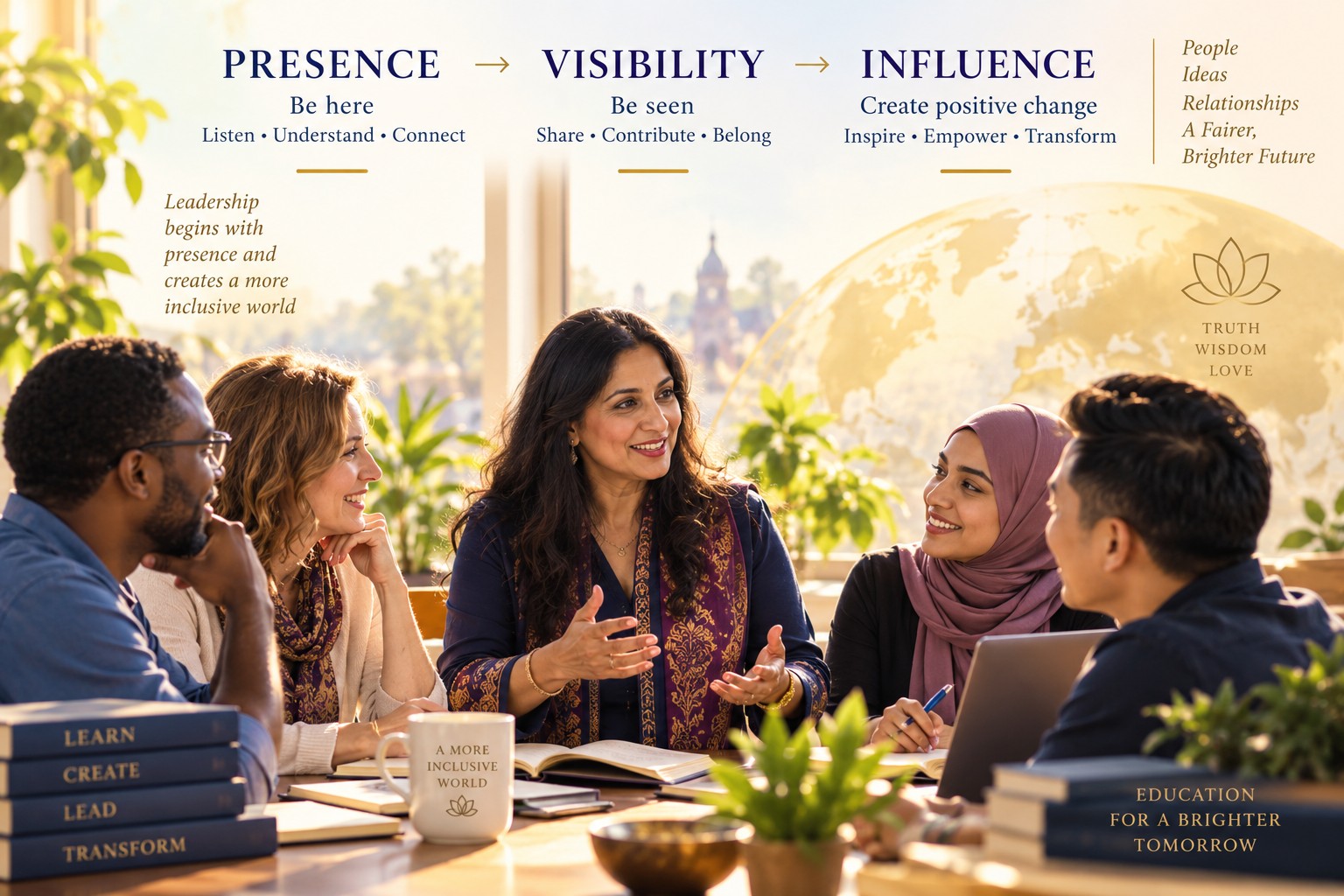
Leadership is often associated with position, authority, status and influence. Yet there is something more fundamental that comes before all of these: presence. Before asking how visible a leader is or how much influence they possess, we might first ask: How fully present are they — to themselves, to other people and to the world around them? Presence is not the same as visibility, and visibility is not the same as influence. Understanding the relationship between these three concepts offers a different way of thinking about leadership.
Presence begins within.
In my earlier work on Presence and Creativity, I explored the experience of being fully present in one’s body as a form of personal power. When we are physically centred, we are more capable of maintaining our balance and resisting external pressure. I wondered whether the personal power described in yogic and martial arts traditions might be closely connected with what we call presence.
But the significance of this idea extends well beyond physical balance.
Leaders are continually exposed to external pressures: expectations, organisational politics, deadlines, competing interests, criticism, praise, opportunities and threats. If our attention is always located somewhere outside ourselves — anticipating other people’s judgements, seeking approval, pursuing status or responding reactively to events — we risk losing our centre.
Leadership presence therefore involves being sufficiently grounded to ask:
Who am I? What do I value? What am I feeling? What am I noticing? Why does this matter to me?
This is not self-absorption. It is self-awareness as a prerequisite for purposeful action.
There is a connection here with the ideas I subsequently developed through my 7D Thinking Framework, particularly the Inside dimension: the unknown, invisible and intrapersonal realm. Leadership is not simply something we perform externally. Our behaviour emerges from complex interactions between our perceptions, values, emotions, identity and the systems in which we participate.
Presence allows us to notice these interactions before simply reacting to them.
One of the apparent paradoxes I explored in Presence and Creativity concerned creativity itself.
As a creative writer, I recognised that some of my writing emerged through something resembling a stream of consciousness, when imagination seemed to take me somewhere beyond immediate physical awareness. Yet I concluded that authentic creativity nevertheless requires us to be present to ourselves and our values, rather than producing work primarily to please other people.
I wrote:
“There is power in our words when they come from our own heart and soul and when these words ring true for others.”
I now see this as equally important for leadership.
A leader can become highly skilled at performing what an organisation expects leadership to look like. They can learn the vocabulary, dress codes, behaviours and conventions associated with authority.
But performance is not necessarily presence.
Presence involves congruence between the person we are, the values we hold, the words we speak and the actions we take.
That alignment creates a very different kind of authority.
In Learn to Lead, I made a simple observation:
“Leaders need to be visible to be recognised and a strong presence is one of the ways to gain this visibility.”
There is an important relationship here:
Presence → Visibility → Recognition → Influence
But I no longer think we should assume that this progression happens automatically.
A person may possess considerable knowledge, wisdom, creativity and integrity while remaining relatively invisible within an organisation.
Conversely, someone may be extremely visible while possessing relatively little substantive influence on the people or systems around them.
Visibility is therefore partly personal and partly systemic.
This distinction matters because it shifts the leadership question away from simply asking individuals how they can make themselves more visible. It also requires us to examine the environments in which visibility and recognition are produced.
Who gets noticed? Whose contribution is valued? And whose expertise can remain unseen even when they are physically present?
In organisations, visibility is not distributed equally.
Some people are invited into influential spaces. Others have to ask to enter them.
Some people’s contributions are noticed and remembered. Others may make substantial contributions that remain largely invisible.
Some are introduced to influential networks, sponsored for opportunities and publicly praised. Others perform equally valuable work without acquiring the same organisational recognition.
I explored this directly in Learn to Lead. I contrasted presence — something over which we can exercise considerable personal agency — with invisibility, which can be produced by organisational barriers.
An unsupported or intentionally marginalised employee may become invisible when their presence is perceived as threatening rather than supportive of the status quo. Even apparently small organisational practices can contribute to invisibility: being omitted from introductions, not being welcomed back after an absence, or not receiving public recognition for contributions and successes.
This complicates conventional leadership advice.
Telling people simply to “be more visible” can imply that invisibility is an individual deficit.
Sometimes it is not.
Sometimes we need to ask:
Who is being seen?
Whose contribution is being recognised?
Who is being invited into the room?
Who receives the informal introductions, sponsorship and networks through which influence develops?
And perhaps most importantly:
Whose expertise remains invisible even when they are physically present?
These are questions about leadership, but they are also questions about organisational culture, inclusion and power.
This distinction has become increasingly important to me.
If visibility depends entirely upon institutional recognition, people who are excluded from established structures can find themselves caught in a damaging cycle:
Low visibility → Low recognition → Fewer opportunities → Reduced influence → Continuing invisibility
Breaking that cycle may require us to rethink where leadership authority originates.
We do not necessarily have to wait for an organisation to confer visibility upon us.
We can write.
We can research.
We can teach.
We can speak.
We can publish.
We can convene conversations.
We can create communities.
We can develop ideas and share them publicly.
We can make knowledge accessible beyond institutional boundaries.
In Learn to Lead, I describe communicative action as a form of learning and leadership. I use the example of writing about the whiteness of creativity not simply to produce another piece of research, but to challenge the status quo.
I conclude that sharing research with a wider audience can create “a greater level of authority, autonomy and freedom of choice” and enable us to influence and make an impact through communicative action.
This is an important component of how I now understand influence.
Influence can be created through meaningful contribution.
There is, however, a danger in pursuing visibility for its own sake.
Contemporary professional culture can encourage us to treat visibility almost as a commodity: accumulate followers, promote achievements, attend the right events, cultivate influential contacts and construct a recognisable personal brand.
Some of these activities can be valuable.
But visibility without purpose can easily become performance.
My understanding of leadership asks a different question:
Visible for what?
If we seek visibility primarily to acquire status, we may gradually become less present to ourselves. Our attention moves outwards towards how we appear, rather than inwards towards whether our actions remain aligned with our values.
In Learn to Lead, I distinguish prestige from simple financial wealth. Prestige can involve cultural, social and psychological capital, the quality of creative expression, the strength of relationships and the depth of resilience developed through life’s difficulties.
I also argue that, at a certain stage of learning, we may begin to create our own spaces rather than merely accepting the place allocated to us within society.
That distinction is fundamental to authentic leadership.
The question becomes less:
How do I make important people notice me?
and more:
What do I have that is worth making visible?
Influence is sometimes imagined as something one person possesses and exercises over another.
My experience suggests something more relational.
In my earlier work on creativity, I drew upon Csikszentmihalyi’s argument that creativity does not exist solely inside an individual’s head. Ideas acquire significance through interaction with a sociocultural context.
Reflecting on my experience of teams, I observed that people who were most fully present could often help steer the group — sometimes not because they generated the most original idea, but because they could recognise how ideas might create value within the particular context.
This suggests that influence emerges through attention, relationship and connection.
The influential leader is not necessarily the loudest voice.
They may be the person who listens carefully enough to notice what everyone else has missed.
They may ask the question that changes the conversation.
They may connect ideas that previously appeared unrelated.
They may recognise another person’s potential before that individual recognises it themselves.
They may speak a truth that others have noticed but have been reluctant to articulate.
Their influence comes not simply from occupying space, but from adding value to the space they occupy.
My understanding of leadership has also been shaped by community.
Learn to Lead is explicitly autoethnographic, drawing upon a lifetime of learning and leadership and examining the self, relationships and community. Its underlying philosophy is that leaders must continue learning in order to survive, grow and flourish.
My research with the Sikh community in Stafford strengthened another dimension of this thinking: sewa, or selfless service.
I describe sewa as one of the most accessible forms of leadership because it does not depend upon gender, age, formal status, skill level or physical ability.
People contribute whatever they can — cooking, cleaning, serving food, donating resources, mentoring, teaching or caring for others — so that individuals and communities can thrive.
This presents a striking alternative to leadership based upon personal visibility.
Sometimes leadership is visible.
Sometimes leadership is quiet.
Sometimes the person making the greatest contribution is not the person standing at the front.
Presence therefore should not be confused with prominence.
A leader can have profound presence without making themselves the centre of attention.
There is another dimension to influence that has become increasingly important in my work: using our voice purposefully.
Research, writing and public engagement can all become forms of leadership when their purpose extends beyond personal achievement.
Knowledge that remains locked within a thesis, report or institutional repository has limited capacity to influence public understanding.
Knowledge enters social life when it is communicated.
This is one reason I have increasingly brought together autoethnography, public engagement and self-publishing.
Lived experience becomes a source of inquiry.
Inquiry becomes knowledge.
Knowledge is communicated publicly.
Public response generates further dialogue, questioning and learning.
Influence in this sense is not simply persuasion.
It is the ability to create conditions in which people think, question, connect and perhaps see differently.
That is communicative leadership.
Perhaps the real test of leadership presence does not occur when everything is going well.
It occurs when our position is challenged.
This brings me back to the physical exercise that helped stimulate my original thinking about presence.
When attention was imagined several metres ahead of the body, external pressure could easily disturb balance. When attention returned fully to the body, balance became considerably more difficult to disrupt.
The metaphor has stayed with me.
External circumstances can exert considerable pressure upon us. Organisations can recognise us or overlook us. People can praise us or criticise us. Doors can open and close.
We cannot control all of those things.
But we can continue asking:
Where am I?
What do I stand for?
What do I know?
What am I learning?
What do I want to contribute?
Who benefits from my presence?
This is not passive resilience. Sometimes being fully present requires us to challenge what is happening around us.
Indeed, presence may make challenge more likely because we notice contradictions that others have normalised.
I therefore see these three concepts as related, but not hierarchical.
Presence is our capacity to inhabit ourselves and our values fully while remaining attentive to other people and to our environment.
Visibility concerns whether our presence, contribution and expertise can be seen and recognised within the systems and communities we inhabit.
Influence is what becomes possible when our presence and contribution affect ideas, relationships, decisions, practices or systems.
But influence also feeds back into presence.
When we communicate, we encounter other perspectives. When others respond, we learn. When we learn, our understanding of ourselves and our world changes.
The process is therefore recursive:
Presence → Expression → Visibility → Connection → Influence → Learning → Deeper Presence
This is much closer to my understanding of leadership than a ladder leading towards positional power.
There is one final tension worth recognising.
For people whose voices have historically been overlooked, visibility matters.
It matters who appears in leadership.
It matters whose knowledge is cited.
It matters whose creativity is recognised.
It matters whose stories enter the public record.
It matters who gets to define what leadership, scholarship, expertise and success look like.
But gaining visibility should not require us to become somebody else.
The challenge is to become more visible without becoming less ourselves.
That requires presence.
It requires us to remain connected with our histories, communities, values and purposes, while developing the confidence to occupy spaces in which our voices can make a contribution.
For me, this is also why lifelong learning remains inseparable from leadership. In Learn to Lead, I describe learning not as a linear journey but as a cyclical process of rest, exploration, discovery and celebration.
I also argue that mature learning can lead towards fulfilment, emancipation, communicative action, prestige and innovation.
Leadership therefore is never finally achieved.
We continue becoming.
Perhaps we have spent too much time asking:
How can I become more influential?
I would begin somewhere else.
How can I become more present?
Because from presence can come authenticity.
From authenticity can come meaningful expression.
From expression can come visibility.
From visibility can come connection.
And through connection, contribution and communicative action, influence can emerge.
The aim is not simply to become a person whom others notice.
It is to become a person whose presence adds value.
That, for me, is a much more meaningful understanding of leadership.
For readers wishing to explore their own leadership presence, I would leave six questions:
Then add the six questions. I suggest making each numbered concept bold, with the question beneath it:
1. Presence
When I enter a room, conversation or relationship, how fully am I actually there?
2. Values
Are my words and actions aligned with what I say matters to me?
3. Visibility
Where is my contribution visible — and where is valuable work remaining unseen?
4. Voice
Am I waiting for permission to contribute knowledge or ideas that could benefit others?
5. Influence
Am I trying to influence people, or am I creating conditions in which people can think, learn and flourish?
6. Legacy
If my presence leaves an imprint upon the people and systems I encounter, what kind of imprint do I want it to leave?
This article draws upon and develops ideas I have explored through my earlier writing, research and reflective practice, particularly my book Learn to Lead: Using Stories, Synthesis & Questions, first developed through my M.Ed. work in 2022 and subsequently published by University for Life.
In Learn to Lead, I used an autoethnographic approach to reflect upon a lifetime of learning and leadership, exploring themes including presence, visibility, invisibility, identity, relationships, values, communicative action, lifelong learning and influence.
The article also revisits ideas from Presence and Creativity, an earlier article co-authored with Dr Annemieken Van Reepingen. In my contribution to that article, I explored presence as a form of personal power: being centred within ourselves, remaining connected with our values and bringing that presence to the expression of our creativity.
I also considered how authentic creativity acquires greater power when it emerges from alignment with our own values rather than from a desire simply to please others.
Presence, Visibility and Influence represents a further stage in the development of these ideas. Looking back at my earlier work from my present position as an educator, researcher, writer, coach and consultant has enabled me to see more clearly the distinction between presence as an internally grounded quality, visibility as something shaped both by personal agency and by the systems within which we operate, and influence as the capacity to contribute to change through relationships, knowledge and communicative action.
The article should therefore be read as part of an ongoing autoethnographic and scholarly inquiry, rather than as a completely new or disconnected piece of work.
Returning to earlier writing allows me to connect ideas developed at different stages of my professional journey, reinterpret them through subsequent experience, and continue asking what it means to exercise leadership with presence, purpose, authenticity and social responsibility.
Dr Jesvir Kaur Mahil (September 2026)
© 2026 Dr Jesvir Kaur Mahil. All rights reserved.
This article may be shared by linking to this webpage. Please do not reproduce or republish the text without permission.