Dr Jesvir Kaur Mahil · September 2026
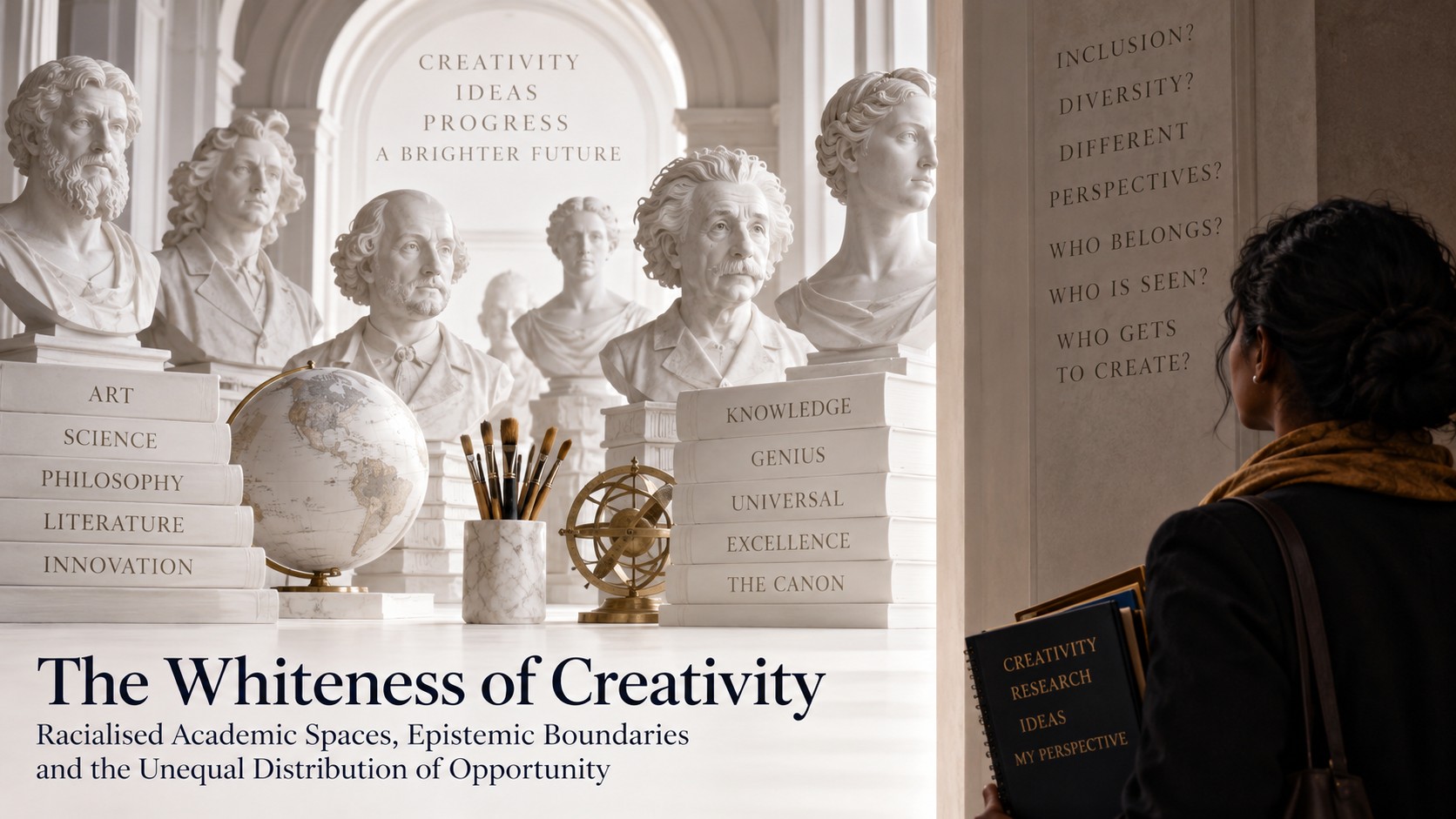
When I entered academia, I brought with me six years of doctoral research into Creativity and Systems Thinking and expected that expertise to become an important part of my academic contribution. Yet across the seven years that followed, I experienced remarkably few institutional opportunities to develop it. At the same time, as a minority ethnic academic willing to challenge racial inequality, I became increasingly involved in Race Equality, EDI, decolonisation and related institutional work. This contrast has led me back to a question first raised through my PhD: Who gets to occupy the space of creativity, whose knowledge is recognised as expertise, and how might academic opportunities themselves become racialised?
When I began researching creativity, I did not intend race to become central to my inquiry.
Indeed, I wrote in my original thesis:
“In an attempt to keep my research mainstream, I intended to steer away from race related issues.”
I wanted to explore creativity “untainted by the colours of racial bias.” Yet the reflexive methodology underpinning my research repeatedly brought Whiteness back into view. What I initially regarded as peripheral became impossible to ignore.
That experience now strikes me as significant.
Why did I consider creativity to be “mainstream”, while race was something from which mainstream scholarship could apparently be protected?
The distinction itself revealed something about the organisation of academic knowledge.
Creativity could apparently exist as a universal intellectual subject.
Race was particular.
Creativity belonged to everybody.
Race belonged to racialised people.
Creativity was scholarship.
Race was an “issue”.
My subsequent academic career would make that distinction considerably more personal.
In my doctoral research, I deliberately used the concept of Whiteness rather than focusing simply upon individual racism.
Drawing particularly upon Gillborn, I understood Whiteness as something broader than the behaviour of individual White people. It concerns socially constructed arrangements of power through which particular identities, perspectives and interests become normalised.
This distinction remains essential.
If we look for racism only through deliberately racist individuals, we may overlook how racial inequalities can be reproduced through ordinary institutional practices.
Whiteness does not necessarily announce itself.
Indeed, its power may lie precisely in its invisibility.
Gillborn’s notion of a “White World”, which I drew upon in my thesis, helped me understand how racialised arrangements can become so normalised that those inhabiting them experience them simply as the world.
This has particular implications for academic spaces.
Walk into certain meetings, conferences, leadership groups or specialist intellectual communities and we may not consciously think:
This is a White space.
We may simply think:
This is the Creativity Conference.
This is the leadership team.
These are the experts.
These are the professors.
These are the people whose ideas matter.
Whiteness disappears because it has become familiar.
My doctoral writing questioned the cultural representation of creativity itself.
When we are asked to think about great artists, scientists, philosophers, inventors or creative geniuses, whose faces come most readily to mind?
Whose creativity has been institutionalised through curricula, museums, universities, textbooks and popular culture?
Drawing on Sarup, I noted how Western art history is frequently narrated through a developmental trajectory beginning with Greece, progressing through the Renaissance and eventually arriving at modern Western art.
Other traditions appear at the margins or are classified differently.
The implication is subtle but profound.
Some people create art.
Others create ethnic art.
Some produce knowledge.
Others produce indigenous knowledge.
Some thinkers produce theory.
Others provide lived experience.
One occupies the universal centre.
The other is marked by difference.
My original paper therefore suggested that creativity viewed exclusively through Whiteness presents only a fragmented picture of human creativity.
I did not then know how personally significant that argument would become.
When I began working at a UK university in 2019, I arrived having recently completed my PhD in Education.
My doctorate represented approximately six years of sustained research into creativity, drawing particularly upon Systems Thinking.
I did not regard this merely as a qualification.
It represented an intellectual contribution I wanted to continue developing.
I expected that entering a university would create possibilities to share this knowledge: delivering workshops, contributing lectures, developing learning experiences around Creativity and Systems Thinking, collaborating with colleagues, continuing research and finding new applications for the conceptual framework I had spent years developing.
That expectation seemed entirely reasonable.
I was bringing specialist knowledge into a knowledge-producing institution.
Yet across the seven years that followed, I was never provided with the kinds of opportunities I had anticipated to establish Creativity and Systems Thinking as a significant strand of my university career.
I continued developing creative ideas.
I created educational approaches and resources.
I incorporated creativity into my own practice where possible.
I contributed initiatives such as storytelling and developed my own thinking and scholarship independently.
But the institutional platform through which my doctoral expertise might have developed into a recognised academic specialism did not materialise.
Meanwhile, another part of my identity and experience became increasingly institutionally relevant:
race.
Across those seven years, I contributed extensively to work concerning race and equality.
I participated in Race Equality work.
I contributed to institutional discussions of systemic racism.
I participated in Equality, Diversity and Inclusion structures.
I contributed to decolonisation work.
I participated in the Race Equality Charter process.
I spent substantial amounts of time identifying, articulating and challenging racial inequality.
Some of this work mattered deeply to me.
I believe universities should confront systemic racism, and I remain committed to social justice.
The difficulty is therefore not that I participated in Race Equality work.
The question is:
Why did the university appear to find greater institutional use for my racialised experience than for the specialist intellectual expertise I had spent six years developing through my doctorate?
This distinction is critical.
There is a profound difference between choosing Race Equality as part of a broad academic identity and gradually feeling obliged to occupy the Race Equality space because inequality remains insufficiently addressed elsewhere.
Over time, challenging racial inequality consumed substantial intellectual and emotional energy.
The more inequality I perceived, the more difficult it became ethically to ignore it.
The more I raised concerns, the more time was required to document, explain and pursue them.
Race Equality work therefore became not simply an additional academic interest but a form of labour.
Meanwhile, Creativity — the field in which I had undertaken my doctoral research — remained largely outside the opportunities made available to me.
This experience has caused me to revisit one of the most important thinkers informing my original analysis: Nirmal Puwar.
In Space Invaders, Puwar examines what happens when bodies historically excluded from particular spaces enter them.
My thesis reflected upon an intriguing reversal.
White researchers conducting race-related research sometimes find themselves explaining their Whiteness because they have entered an intellectual field strongly associated with racialised minorities.
I experienced something different.
As a non-White researcher studying creativity, I found myself having to explain race in a field ostensibly unrelated to race.
I described myself as positioned on the margins of Whiteness.
Seven years later, I would formulate the problem more explicitly:
Academic spaces themselves can become racialised.
Some appear implicitly reserved for bodies possessing what we might describe as white somatic familiarity.
Other spaces appear disproportionately allocated to minority ethnic bodies.
This is rarely written into organisational structures.
There is no sign on the Creativity seminar door saying:
WHITE ACADEMIC SPACE.
There is no notice outside the Race Equality meeting saying:
MINORITY ETHNIC STAFF REQUIRED HERE.
Yet patterns of presence, opportunity and expectation can communicate these boundaries remarkably effectively.
This leads to a proposition I believe deserves much greater attention.
Universities may inadvertently create a racial division of academic labour.
White academics can occupy apparently race-neutral intellectual territories:
creativity;
innovation;
strategy;
leadership;
management;
pedagogy;
entrepreneurship;
technology;
organisational development.
These subjects retain the privilege of appearing universal.
Minority ethnic academics, meanwhile, can become disproportionately visible in:
race equality;
EDI committees;
decolonisation;
anti-racism initiatives;
Race Equality Charter work;
consultations about minority experiences.
These are important spaces.
But there is a danger.
The minority ethnic academic can become institutionally recognised primarily through their difference rather than through the full breadth of their scholarship.
They become the person invited to discuss race.
The person asked about inclusion.
The person whose lived experience gives institutional EDI work authenticity.
The person expected to notice exclusion.
The person expected to explain it.
The person expected to help the institution solve it.
Meanwhile, another question receives much less attention:
What is their disciplinary expertise?
This distinction complicates conventional understandings of diversity.
A university may point to minority ethnic participation in committees, working groups and institutional initiatives as evidence of inclusion.
But counting minority ethnic bodies tells us remarkably little about the distribution of those bodies across institutional spaces.
Suppose minority ethnic academics are highly visible within EDI committees but scarcely visible within senior leadership.
Suppose they are invited to contribute their experiences of racism but not their theories of creativity.
Suppose they participate extensively in decolonisation work but have limited opportunities to lead prestigious intellectual initiatives.
Suppose their racial knowledge is institutionally welcomed while their wider scholarly expertise remains peripheral.
Can we describe that institution as inclusive?
Representation alone cannot answer the question.
We need to examine where representation occurs.
A better set of questions might be:
Who is in the room?
Which room?
Why were they invited?
What are they expected to contribute?
What opportunities arise from being in that room?
And which rooms remain difficult for them to enter?
There is also an important career consequence.
Time is finite.
Every hour spent contributing to institutional Race Equality work is an hour that cannot simultaneously be spent writing a journal article about creativity, developing a research grant, designing a Creativity workshop, building a Systems Thinking research collaboration or establishing a recognised disciplinary profile.
This does not make EDI work unimportant.
Quite the opposite.
It means universities need to recognise its opportunity cost.
When minority ethnic academics undertake disproportionate amounts of equality labour, the institution may benefit while the individual bears much of the cost.
The university gains participation.
It gains lived experience.
It gains credibility for institutional equality initiatives.
It gains colleagues willing to identify problems and propose solutions.
But what does the academic gain?
Does the work lead to promotion?
Does it create research time?
Does it result in recognised leadership?
Does it generate publications?
Does workload allocation properly recognise it?
Does it provide pathways into senior institutional roles?
And perhaps most importantly:
Does it consume precisely the time and energy required to accumulate the conventional achievements subsequently used to determine who deserves advancement?
This is where inclusion can produce a paradox.
The work undertaken to make the university more inclusive can itself contribute to cumulative disadvantage if the people disproportionately undertaking that work sacrifice opportunities to develop the forms of capital the university rewards elsewhere.
The contrast in my own trajectory is particularly striking because Creativity was not a casual interest.
I had devoted approximately six years to doctoral research in the field before joining the university.
Yet expertise does not become institutionally valuable merely because someone possesses it.
It must be recognised.
It must be invited.
It must be given a platform.
It must be connected to opportunities.
It must become visible to people who control resources.
Without those conditions, expertise can remain almost invisible.
This raises an uncomfortable question about academic merit.
We often assume that successful academics progress because their expertise becomes stronger and more valuable.
But perhaps institutional careers also depend upon something prior to merit:
the opportunity to demonstrate merit in spaces where merit is recognised.
If one academic is repeatedly invited to speak, lead, research and develop within their specialist field, their expertise becomes increasingly visible.
Visibility generates further opportunity.
Opportunity produces experience.
Experience produces credibility.
Credibility generates more opportunity.
Another academic may possess substantial expertise but receive few opportunities to exercise it institutionally.
Over time, the difference between their career trajectories can appear to demonstrate differences in merit.
But part of that difference may have been produced by the distribution of opportunity itself.
My doctoral work originally asked whether creativity itself had become culturally framed through Whiteness.
My subsequent experience leads me towards a broader question:
Do universities racialise expertise?
There are many minority ethnic academics working successfully in Creativity, innovation and senior academic leadership, just as there are White academics making substantial contributions to anti-racism and EDI.
The argument is therefore not that academic spaces are literally reserved according to race.
That would be too crude.
The proposition is subtler.
Some academic spaces may become culturally associated with racial types to such an extent that particular bodies appear naturally to belong there, while others become more noticeable, more exceptional or more easily positioned elsewhere.
White somatic appearance can remain unremarkable within spaces associated with intellectual authority.
Minority ethnic appearance becomes particularly visible within spaces associated with diversity.
One is permitted to be simply:
an academic studying creativity.
The other can become:
a minority ethnic academic studying creativity.
That additional descriptor matters.
It demonstrates that one identity occupies the unmarked centre while another remains marked by racial difference.
This can place minority ethnic academics in a difficult double bind.
If we do not contribute to Race Equality work, we may watch inequalities affecting ourselves and others remain unchallenged.
If we do contribute, we may spend significant amounts of time performing labour that is peripheral to the disciplinary profile through which conventional academic careers progress.
If we speak repeatedly about racism, we risk becoming institutionally associated primarily with racism.
If we remain silent, the institution loses precisely the perspectives required to identify systemic inequality.
And if we challenge unfairness persistently, our challenge itself can eventually become interpreted as problematic behaviour.
This is not meaningful empowerment.
It is a structural dilemma.
I entered university employment wanting to talk about creativity.
Increasingly, circumstances required me to talk about race.
There is something deeply revealing in that transition.
It would be possible to interpret the absence of opportunities to develop my Creativity and Systems Thinking expertise as an isolated professional disappointment.
Perhaps there was no suitable opportunity.
Perhaps institutional priorities lay elsewhere.
Perhaps I should have done more to promote my expertise.
But when we examine a seven-year trajectory rather than isolated incidents, a different kind of question becomes possible.
I entered the university with substantial professional experience and doctoral expertise.
I sought opportunities for recognition and progression.
I contributed extensively to equality initiatives.
I raised concerns about systemic racism and unfair treatment.
I continued to develop ideas around creativity, learning, leadership and innovation.
Yet the trajectory I had anticipated in Creativity and Systems Thinking did not materialise.
Seven years later, my university employment ended in summary dismissal.
I do not claim that the absence of Creativity opportunities caused my dismissal, nor that a single explanation accounts for seven years of complex organisational relationships.
The argument is methodological rather than simplistic.
The appropriate unit of analysis may be the trajectory rather than the incident.
Instead of asking only whether any single decision can be explained independently, we might ask:
What knowledge did the person bring into the institution?
What knowledge became recognised?
What forms of labour were they repeatedly asked to undertake?
In which spaces were they welcomed?
Which spaces proved more difficult to enter?
What opportunities accumulated over time?
Which opportunities did not?
And what happened when they began challenging those patterns?
These questions can reveal dimensions of cumulative disadvantage that may disappear when organisational decisions are examined one at a time.
My background in Systems Thinking encourages me to look beyond individual decisions and examine the relationships between identity, space, opportunity, labour, recognition and career progression.
From this perspective, racialised academic space can become self-reinforcing.
One possible cycle operates like this:
Academic spaces acquire racialised norms.
Some bodies appear more naturally to belong within those spaces.
Familiarity influences the distribution of opportunities.
Opportunity creates visibility and experience.
Visibility and experience become interpreted as expertise.
Recognised expertise generates further opportunities.
Existing patterns of representation are therefore reinforced.
A second cycle may operate alongside it:
Minority ethnic academics experience or recognise inequality.
They become recruited into, or feel compelled to contribute to, EDI and Race Equality work.
Time and emotional labour are invested in addressing inequality.
Less time and opportunity remain for disciplinary scholarship and conventional career-building activities.
Their institutional identity becomes increasingly associated with EDI.
Their wider disciplinary expertise becomes less visible.
Future invitations reproduce the same roles.
These processes do not require deliberate coordination.
Systems can produce patterned outcomes without anybody designing the whole system to produce them.
That is precisely why a systemic analysis matters.
It shifts our attention from asking only:
“Who discriminated?”
towards the broader question:
“What relationships, practices and feedback loops repeatedly produce unequal patterns of opportunity?”
Nirmal Puwar’s concept of the “space invader” helps illuminate what happens when bodies historically excluded from particular institutional spaces begin to occupy them.
But perhaps universities need to go further than enabling minority ethnic academics to become successful space invaders.
They should enable them to become space makers.
By this I mean having the institutional opportunity and authority to create intellectual spaces, rather than merely being invited into spaces whose purposes and boundaries have already been defined by others.
This invites me to consider a counterfactual question about my own academic career.
What might have happened if the six years of doctoral research into Creativity and Systems Thinking that I brought into the university had been treated as an institutional resource?
Might I have developed Creativity workshops?
Might I have created Systems Thinking programmes?
Might interdisciplinary collaborations have emerged?
Might students have benefited from this expertise?
Might further research have developed?
Might my academic profile have looked different seven years later?
These questions cannot now be answered because those opportunities did not happen.
This reveals one of the central difficulties in understanding cumulative disadvantage:
We can document what happened much more easily than we can measure what was prevented from happening.
A workshop that was never offered leaves no attendance register.
A lecture that was never delivered produces no student evaluations.
A research collaboration that was never initiated produces no publication.
A leadership opportunity that was never offered creates no line on a CV.
Absence generates remarkably little evidence of itself.
Yet accumulated across seven years, such absences can profoundly shape a career.
If universities are serious about inclusion, they need to move beyond simply measuring representation.
They also need to examine the distribution of opportunity.
We should ask:
Who gets to teach what?
Who gets to research what?
Who gets to lead what?
Who is repeatedly asked to undertake EDI work?
Who receives workload recognition for that labour?
Who is given opportunities to develop their disciplinary expertise?
Who becomes associated with innovation, and who becomes associated with race?
Who is invited into strategic conversations?
Whose knowledge is treated as universal, and whose as experiential?
Who is permitted to be recognised as an expert without their race preceding their expertise?
And perhaps most importantly:
What expertise entered the university through minority ethnic staff but was never given sufficient institutional space to flourish?
This moves the conversation from representation towards what we might call epistemic opportunity.
It is not enough to ask whether diverse people have entered the university.
We must also ask whether the full range of knowledge, creativity, expertise and intellectual possibility they brought with them has been allowed to enter too.
I began my doctoral research wanting to study creativity without making race central to the inquiry.
Race refused to remain outside it.
My original research suggested that when creativity is viewed predominantly through Whiteness, we see only a fragmented picture of human creativity.
Drawing upon Foucault, I became interested in the ways that a “regime of truth” can shape what becomes visible, legitimate and valuable as knowledge.
Seven years of subsequent experience in higher education have caused me to revisit that argument from a different perspective.
The question is no longer simply:
Is creativity represented through Whiteness?
It is also:
Who is given institutional permission to occupy the space of creativity?
Who gets to become recognised as a creativity expert?
Who gets to innovate?
Who gets to theorise?
Who gets to be intellectually playful?
Who gets to occupy academic spaces without having to explain their racial presence within them?
And conversely:
Who becomes expected to talk about race?
Who performs the intellectual and emotional labour of equality?
Who is repeatedly called upon when institutions need diversity?
Who becomes visible primarily through their racial difference?
The racial distribution of academic space is therefore not simply a question of representation.
It is a question of power, knowledge and opportunity.
An institution can value minority ethnic staff while simultaneously channelling them towards EDI work.
It can celebrate diversity while failing to recognise the disciplinary expertise those colleagues bring.
It can provide someone with a seat at the Race Equality table without providing equivalent opportunities within Creativity, innovation, strategy — or to create entirely new tables of their own.
There is also an institutional opportunity cost.
If six years of specialist research into Creativity and Systems Thinking remain substantially underused, it is not only the individual academic who loses.
Students lose possible learning experiences.
Colleagues lose possible collaborations.
The university loses intellectual capital.
Knowledge that might have developed remains underused.
There is a particular irony here.
A university may invest considerable effort in increasing the racial diversity of its workforce while failing to benefit fully from the diversity of knowledge those bodies bring with them.
Genuine inclusion therefore requires more than creating EDI spaces for minority ethnic academics.
It requires opening the entire intellectual landscape of the university.
It means recognising people as mathematicians who happen to be Black; philosophers who happen to be Asian; researchers, leaders, scientists, artists, educators and systems thinkers whose intellectual identities cannot be reduced to their racial identities.
In my own case, it means recognising a Sikh woman who did not enter academia principally to become an expert in explaining racism to universities, but who arrived carrying six years of research into Creativity and Systems Thinking and expected to be given opportunities to create.
That brings me back to the question at the heart of this paper:
Who gets the freedom to be creative, and who is required to spend their creativity explaining why they have not been equally free?
This article develops an argument that began in my doctoral research, completed in 2018, where I explored the “Whiteness of Creativity” through Critical Race Theory, Whiteness, Systems Thinking and reflexive inquiry.
Here, I revisit that earlier work through autoethnographic reflection on my subsequent seven years of experience within UK higher education.
The purpose is not to attribute discriminatory motives to particular individuals. Rather, it is to examine how academic spaces, expertise, institutional labour and opportunities can become racialised through ordinary organisational practices, including practices undertaken in the name of equality and inclusion.
By bringing my earlier scholarship into dialogue with subsequent lived experience, I seek to make visible patterns that can be difficult to recognise when events are considered separately.
The wider question is therefore not simply whether universities contain diverse people, but whether they create the conditions in which the full diversity of knowledge, expertise and creativity those people bring can flourish.
Dr Jesvir Kaur Mahil (September 2026)
Delgado, R., Stefancic, J. et al. (2012). Critical Race Theory: An Introduction. 2nd ed. New York: NYU Press.
Foucault, M. (1980). Power/Knowledge. UK: Harvester Press.
Gaine, C. (1995). Still No Problem Here. UK: Trentham Books.
Gillborn, D. (1990). Race, Ethnicity and Education. London: Unwin Hyman.
Gillborn, D. (2008). Racism and Education: Coincidence or Conspiracy? London: Routledge.
Goodfellow, M. (2014). “The Acceptable Face of Creativity: How Media Diversified Creatively Challenges the ‘Ubiquity of Whiteness’ in the Media.”
Puwar, N. (2004). Space Invaders: Race, Gender and Bodies Out of Place. Oxford: Berg.
Sarup, M. (1991). Education and the Ideologies of Racism. UK: Trentham Books.
Sleeter, C. E. (2017). “Critical Race Theory and the Whiteness of Teacher Education.” Urban Education, 52(2), 155–169.
Troyna, B. (1998). “‘The Whites of My Eyes, Nose, Ears…’: A Reflexive Account of ‘Whiteness’ in Race-Related Research.” In P. Connolly & B. Troyna (eds.), Researching Racism in Education. UK: Open University Press.
© 2026 Dr Jesvir Kaur Mahil. All rights reserved.
This article may be shared by linking to this webpage. Please do not reproduce or republish the text without permission.